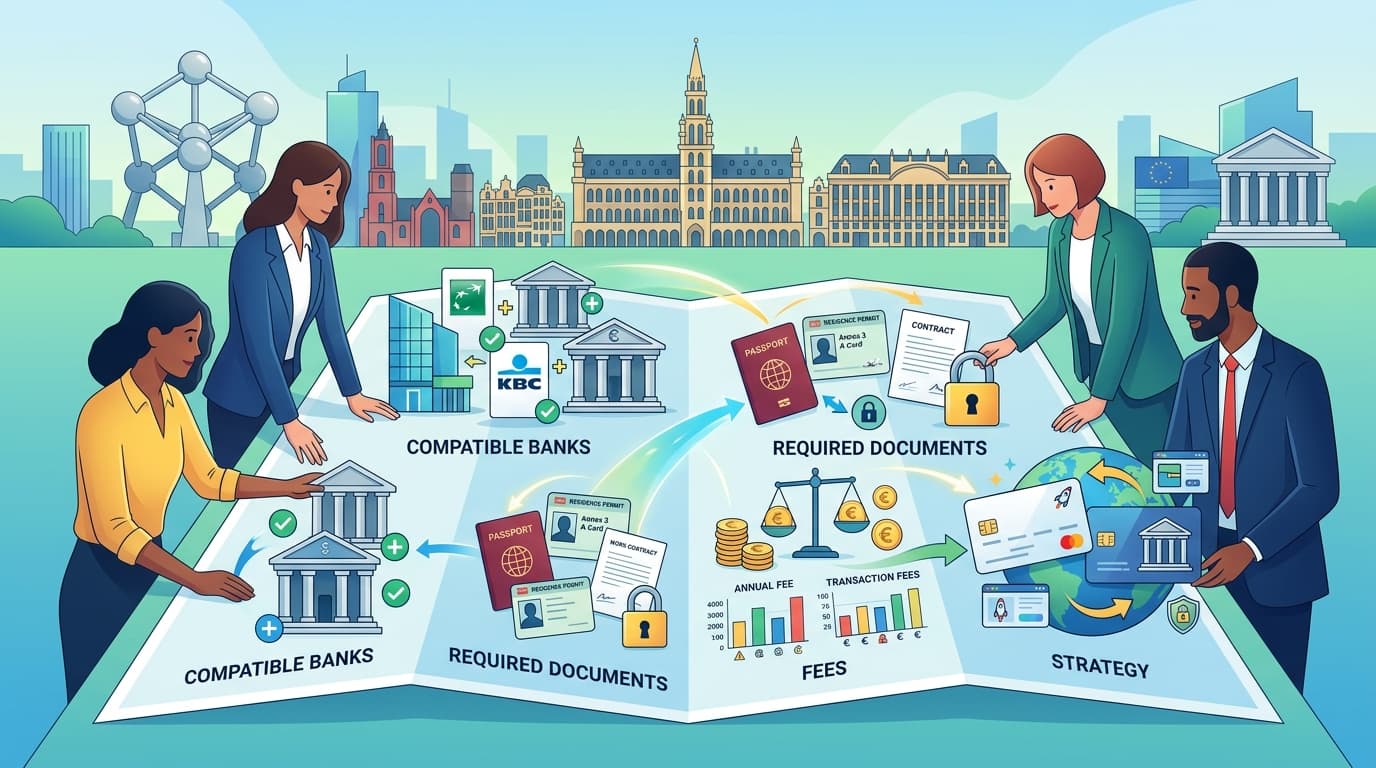
1.63 million residents of foreign nationality live in Belgium as of 1 January 2025, according to Statbel — 13.8% of the population. In Brussels, 37% of the population does not hold Belgian nationality — French, Romanians, Italians, Spaniards and Moroccans lead the list. Yet getting a Belgian credit card as a newcomer remains poorly documented. Banks have "expat packages", neobanks cover daily payments, but nobody says clearly what to get, in what order and why.
Do you need Belgian nationality to get a credit card?
No. No Belgian bank requires Belgian nationality. What matters: a valid residence permit, regular income and a bank account domiciled in Belgium. The bank is legally required to consult the Centrale des Crédits aux Particuliers (CCP) at the National Bank before granting any credit — including a credit card. If you have just arrived, your CCP file will be blank, which is not a dealbreaker. A blank file means "no payment defaults", not "high risk".
In practice, banks evaluate three criteria: income stability (a permanent contract carries more weight than a fixed-term one), the debt-to-income ratio (maximum 33% of net income) and duration of residence in Belgium. Some require 3 to 6 months of local banking history before issuing a card, others accept applications upon account opening — that is the difference between banks that treat expats as a commercial segment and those that apply standard criteria without adaptation.
Which Belgian banks accept expats?
Five banks offer a structured proposition for non-Belgians. Conditions vary on three axes: English-language support, remote account opening and immediate access to a credit card.
| Bank | Expat package | Monthly cost | Credit card included | Remote opening | Languages |
|---|---|---|---|---|---|
| KBC Brussels | Plus Account Expat | EUR 4.25 | Yes (Mastercard) | Yes | FR, NL, EN |
| BNP Paribas Fortis | Easy Guide Pack | EUR 5.50 | 2 cards (Visa + MC) | Yes | FR, NL, EN |
| ING | Do More Pack | EUR 1.90* | Yes (Visa Classic EUR 27/yr) | Partial | FR, NL, EN |
| Belfius | Beats Pulse | EUR 0 | No (supplement) | Yes | FR, NL |
| Beobank | No package | — | Visa Classic EUR 5/yr | In-branch | FR, NL |
KBC Brussels stands out for expats thanks to one detail the others do not offer: the ability to apply for a current account online without being domiciled in Belgium or holding Belgian nationality. The account is functional once validated online — you simply visit a branch upon arrival to sign and collect your debit card. The credit card is linked at no extra cost.
BNP Paribas Fortis targets long-term expats with its Easy Guide Pack at EUR 5.50/month: two credit cards, home insurance and English-language support. The service is comprehensive for those settling with a family.
*ING: the Do More Pack costs EUR 22.80/year (EUR 1.90/month) with salary domiciliation of at least EUR 700/month. The Visa Classic costs EUR 27/year extra — free the first year.
Beobank deserves a mention: it is the only Belgian issuer that delivers a credit card without requiring a current account with them. The Visa Classic at EUR 5/year with a EUR 2,200 limit can serve as a first Belgian credit card if your main bank refuses or delays.
Credit card or neobank: which strategy to adopt?
Both. This is not a binary choice. Revolut, Wise, N26 and Bunq offer no credit card in Belgium — only prepaid debit cards. They are unbeatable for currency exchange (interbank rate on Wise and Revolut on weekdays), but they do not build a CCP history and are refused for car rental deposits or hotel guarantees in many cases.
| Criterion | Belgian credit card | Neobank (Wise/Revolut) |
|---|---|---|
| FX outside eurozone | 1.5 – 3% fees | 0 – 0.5% (interbank rate) |
| Car rental | Accepted (deposit) | Often refused |
| CCP history | Yes (builds profile) | No |
| Foreign ATM withdrawal | EUR 5 + 1 – 1.5% | Free up to EUR 200/month |
| Deferred payment | Yes (end of month) | No (instant debit) |
| Travel insurance | Depends on card (Gold) | Depends on plan (Premium+) |
What this means for you: use Wise or Revolut to send money to your home country, pay in pounds or dollars and withdraw cash abroad. Use your Belgian credit card for everyday euro spending, car rental, hotel bookings and building your banking profile in Belgium.
For a detailed comparison of neobanks, see our Revolut vs N26 analysis for Belgium. And if you travel frequently outside the eurozone, our guide to fee-free travel cards breaks down foreign exchange fees bank by bank.
How to build a credit history in Belgium
The CCP records two types of information: the positive section (all current credits) and the negative section (payment defaults). An expat arriving with a blank file has neither — which is not a negative signal, but does not reassure a mortgage lender either.
The three-step strategy:
-
Month 1 — Open an account with a credit card (KBC Brussels, BNP or ING). Starting limit: EUR 1,500 to 2,500 depending on the bank and your income.
-
Months 1 to 12 — Use the card for everyday spending (groceries, fuel, subscriptions). Repay the full balance each month — never pay interest.
-
After 12 months — Your CCP profile shows regular credit without incidents. You can request a limit increase, a Gold card with travel insurance or begin a mortgage application.
An important detail: an expat who uses exclusively Revolut or Wise for two years in Belgium will have no trace at the CCP. The day they apply for a mortgage, the bank will have nothing to evaluate. Starting early with a standard credit card — even at a low limit — is an investment in your Belgian financial profile.
To understand how the CCP works and its impact on credit applications, our CCP registration guide covers the full procedure.
What fees should expats watch for?
The fees that specifically penalise expats are linked to currency exchange and international transactions — not the base annual fee, which is identical for all residents.
Foreign exchange (FX) fees: Belgian banks charge 1.5 to 3% on every payment in a foreign currency. Belfius applies 1.5% via its Mastercard, BNP Paribas Fortis charges 1.6%. Neobanks offer the interbank rate (Wise, Revolut on weekdays) — the difference is significant if you regularly pay in pounds, dollars or kronor.
DCC (Dynamic Currency Conversion): when a terminal abroad offers to charge you "in your currency" (euros), always decline. The merchant's rate adds 3 to 5% above the interbank rate, on top of your bank's own fees. Always choose the local currency.
Foreign ATM withdrawals: Belgian banks charge a flat fee of EUR 5 plus 1 to 1.5% of the amount withdrawn outside the eurozone. Wise and Revolut offer EUR 200 in free withdrawals per month.
Our comprehensive guide to hidden fees lists all charges by bank, and our comparison of free credit cards identifies options with no annual fee.
Comparator Guides & Advice
Compare side by side.
Compare now →
Frequently asked questions
Keep reading
Sophie L. worked eight years in a Belgian bank branch, first as a credit adviser and then in customer relations, before going independent in 2021 and settling in Louvain-la-Neuve. Her work starts with the issuers' official fee schedules, from the high-street banks (ING, BNP Paribas Fortis, KBC, Belfius) to the neobanks (Revolut, N26, Wise), reduced to five comparable lines: annual fee, currency conversion charge, borrowing rate, spending limits and bundled insurance. Every price on this site carries the date it was checked: the annual-fee grid was gone through line by line on 12 August 2026, after Belfius moved its Beats Star package to 5.90 € a month in February. If an issuer does not publish a figure, she writes that down instead of estimating it. For readers who moved to Belgium, she spells out what a Belgian issuer expects from an applicant with no local credit history.