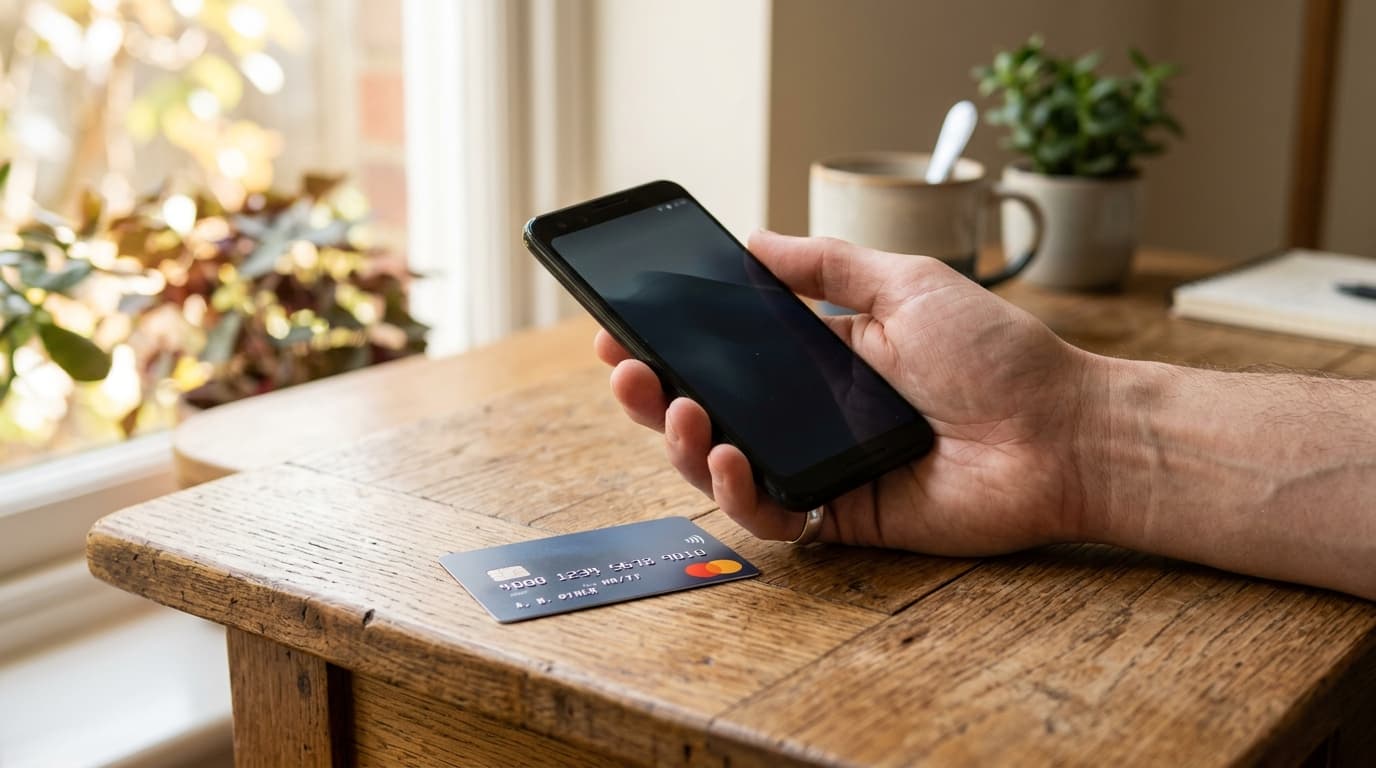
Picking a credit card on its annual fee alone ignores the thing you actually touch every day: the app. Freezing a card in ten seconds, raising a limit before a purchase, seeing every payment land as a notification, those actions are often worth more than 20 EUR off the fee. In Belgium the gaps between Belfius, KBC, ING and Revolut are real, and the ranking holds a surprise: the best app on the market does not run a credit card at all.
Which credit card is easiest to run from an app in Belgium?
Belfius and KBC lead for a genuine credit card. Their apps let you block and unblock the card, adjust limits and receive a notification on every payment, without calling anyone or walking into a branch.
This is not just an impression. Consultancy Sia Partners named Belfius Mobile the best banking app in the world among large universal banks, across a panel of 79 banks from Belgium, France, the United Kingdom, the Netherlands, Luxembourg, Spain, Italy, Canada, Hong Kong and Singapore, with KBC fourth. The study dates from 2020, and I quote it with that caveat: six years on, ING and Argenta have largely closed the gap on core functions.
In practice, the credit card remains the poor relation inside these apps. The fine settings you know from your debit card, limits per channel, contactless toggle, blocking payments outside Europe, are not all available for the Mastercard or Visa attached to the same account. That is the first gap to check before choosing.
What digital controls do Belgian banking apps really offer on a credit card?
Three functions are widespread, a fourth is not. Temporary blocking, limit changes and payment notifications exist at the large Belgian banks. The disposable virtual card remains a neobank speciality.
At Belfius, the Mastercard limit is changed in the app through Settings, Payment methods, Cards, then Manage my limits, and the new limit applies as soon as the request is approved. Temporary blocking sits in the same place: with the card blocked, every payment and withdrawal is refused, contactless included. At KBC the same setting sits under My KBC, in payment methods.
| Issuer | Real credit card | Temporary block | Limit in app | Disposable virtual card |
|---|---|---|---|---|
| Belfius | Yes, Mastercard | Yes | Yes | No |
| KBC | Yes | Yes | Yes | No |
| ING | Yes, Mastercard | Yes | Yes | No |
| Revolut | No, debit card | Instant freeze | Yes | Yes |
The verdict fits in one sentence: to run a Belgian credit card, Belfius and KBC do the job; for serious digital controls, no Belgian bank matches Revolut.
Can you block a card permanently from the app?
No, and plenty of people find this out too late. In Belgium, permanently blocking a lost or stolen card goes through Card Stop, whatever your bank. The app handles temporary blocking, the one you use when the card has vanished from your wallet but might still turn up under the sofa. Once the theft is established, Card Stop is mandatory, and the app does not replace that call.
Do limits really change in real time?
Partly. Lowering a limit is instant, raising a credit card limit remains a request subject to approval, because it is a credit line. At Belfius the new limit applies once the request is approved. In practice, if you know you will be blocking a 1,500 EUR deposit at a car rental desk on Saturday morning, set the limit during the week, not in the rental car park.
Why do the best digital controls belong to a card that is not a credit card?
Because Revolut, N26 and bunq do not issue credit cards in Belgium. Their cards are debit cards, and it is precisely the absence of a credit line that lets them open every setting to the user without prudential risk.
Revolut offers instant freeze and unfreeze, disposable virtual cards whose number changes after each purchase, authorisation or blocking by payment type, online, contactless, withdrawal, and a notification the second a payment goes through. No Belgian bank matches that set on a credit card. The paradox is complete: the best-controlled card on the Belgian market is the one that will not work as a deposit at Hertz or Sixt, because it is not a credit card.
What this means for you: the question of which card has the best app has no single answer, it splits in two. For day-to-day security and online purchases, a free Revolut wins. For deposits, deferred debit and purchase insurance, you need a Belgian credit card, and then you pick the bank whose app does not force you to pick up the phone. Our neobank comparison covers each one in detail.
Does a premium card come with better digital features?
No. This is a stubborn misconception. An ING Mastercard Gold at 51 EUR a year and a classic card from the same bank run from the same app, with exactly the same settings and the same notifications.
The premium fee buys insurance, a higher limit, sometimes airport lounge access. It does not buy extra digital controls. The fee gap between a classic card and a Gold therefore funds no extra function in the app: it changes the amount debited, not the settings screen. If digital control is your motivation, change bank or add a neobank, do not move up a tier.
One detail worth noting: at Revolut, digital features are tied to the paid plan. Disposable virtual cards and some advanced controls depend on the subscription. The logic is the reverse of Belgian banks, where the premium tier is about insurance.
Which card should you pick if you want to manage everything from your phone?
It depends on what you want to control. For a genuine credit card run from a phone, a KBC customer takes the KBC credit card, free until 29 with the Visa Vision, and manages everything from KBC Mobile. A Belfius customer is just as well served.
For maximum security on online purchases, add a free Revolut and pay with a disposable virtual card: the number used at a dubious merchant will never work again. The two-card setup, a Belgian credit card for deposits and credit, a neobank debit card for controls and currency exchange, covers both needs for under 25 EUR a year. That is what I use, and I have found nothing better on the Belgian market in 2026.
FAQ
The questions above cover the most common cases. To go further, our Belgian card comparison, the guide to credit card fraud and the one on virtual credit cards take the analysis further.
Comparator Guides & Advice
Compare side by side.
Compare now →
Frequently asked questions
Keep reading
Sophie L. worked eight years in a Belgian bank branch, first as a credit adviser and then in customer relations, before going independent in 2021 and settling in Louvain-la-Neuve. Her work starts with the issuers' official fee schedules, from the high-street banks (ING, BNP Paribas Fortis, KBC, Belfius) to the neobanks (Revolut, N26, Wise), reduced to five comparable lines: annual fee, currency conversion charge, borrowing rate, spending limits and bundled insurance. Every price on this site carries the date it was checked: the annual-fee grid was gone through line by line on 12 August 2026, after Belfius moved its Beats Star package to 5.90 € a month in February. If an issuer does not publish a figure, she writes that down instead of estimating it. For readers who moved to Belgium, she spells out what a Belgian issuer expects from an applicant with no local credit history.