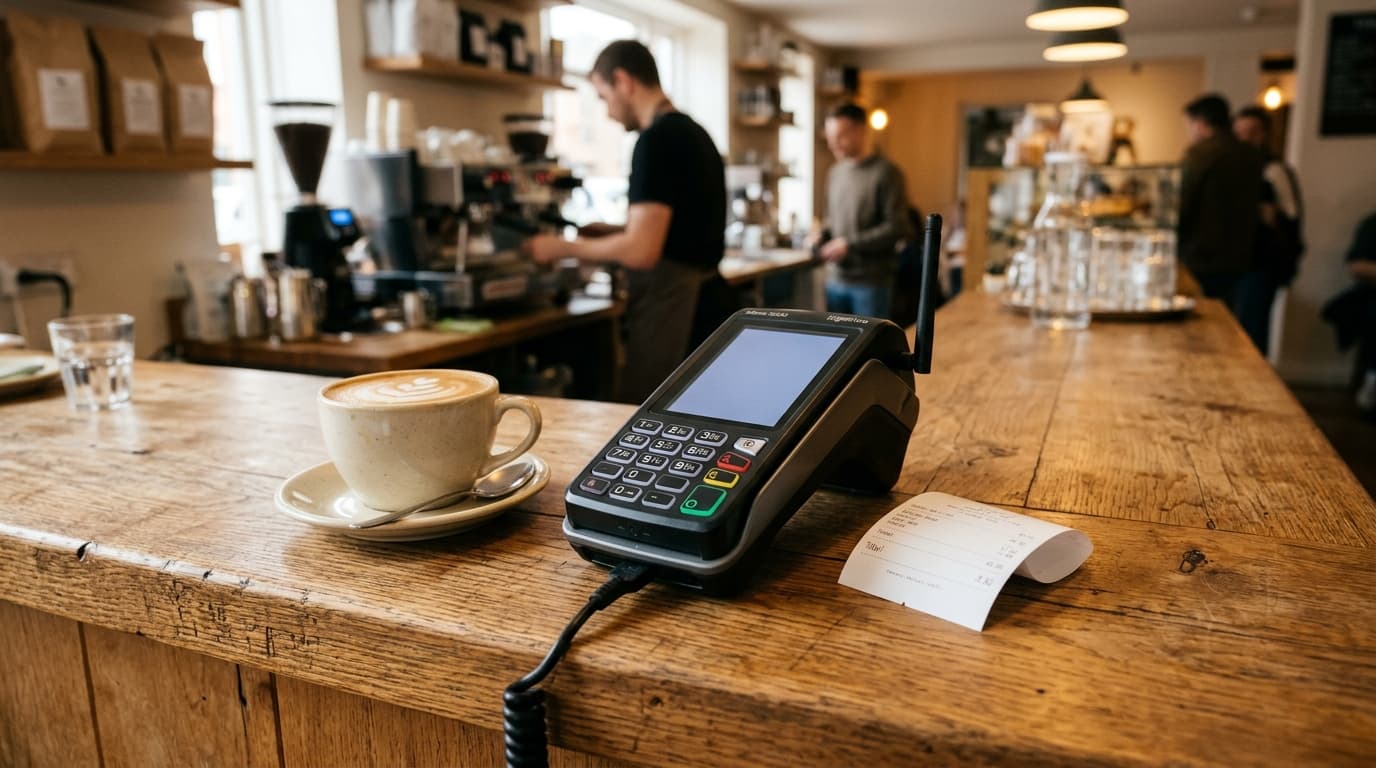
A payment authorisation only says that the card exists, that it is not blocked and that no limit has been hit. It promises neither sufficient funds, nor that the merchant will be paid, nor that the payment will never be disputed. The Belgian acquiring contract I read on 26 October 2026 aims to settle the merchant on the second business day after the operation is received.
The terminal said yes. Nothing is paid yet.
The terminal's yes checks three points, and Worldline's contract lists them
Worldline equips many Belgian merchants with terminals and receives the sales money for them: that is what an acquirer is. Its acquiring service conditions (French), version 2025/10 (reference 202510.BE-FR), are online. Article 4.4 requires the merchant to request and receive an authorisation for every transaction, unless a contractual module says otherwise, and forbids accepting the transaction if it is not obtained. Article 4.5 fixes the value of that authorisation: it only verifies whether a card exists, whether it is not blocked and whether no limit has been exceeded.
Between the terminal and the issuer runs a network, Visa or Mastercard for most credit cards (see Visa versus Mastercard). The pillar on how a credit card works describes the three stages of a payment, and the basics glossary defines authorisation and clearing. What they lack is the text that governs the relationship between the merchant and its acquirer, the one that sets the delays and the guarantees. I use it as a calendar, and the table below draws the clocks from it.
Each step has its own, and none of them belongs to the cardholder.
| Step | Delay | Source |
|---|---|---|
| Terminal response | Under 5 seconds in a French description from 2019 | MoneyVox (French), 16 December 2019 |
| Submission by the merchant | 48 hours after execution | Worldline, article 10.1 |
| Settlement to the merchant | J+2, every business day | Worldline, articles 11.1 and 11.2 |
| Resubmission of a lost transaction | 60 days (debit), 180 days (credit) | Worldline, article 10.4 |
| Refund to the cardholder | 180 calendar days, shorter limits possible | Worldline, article 7.3 |
| Evidence in a dispute | 4 calendar days after Worldline's request | Worldline, article 12.3 |
| Release of a fund hold | Without undue delay, at the latest on receipt of the order | Directive 2015/2366, article 75 |
Why does a "pending" line not prove that the money has moved?
Because the terminal's yes and the movement of money take place neither at the same time nor between the same parties. The issuer answers within seconds. The merchant then submits its operations, within 48 hours, and Worldline settles them on a J+2 basis.
What the app shows in the meantime depends on the bank, and my sources contradict each other. Our pillar says that nothing is debited at that moment, even on a debit card. Wikifin (French), in a page updated on 14 July 2026, writes that payments and withdrawals are "almost immediately" debited from the current account. I do not know which of the two describes your bank, and only the issuer's app is authoritative. The gap between debit and credit is covered in our guide on credit card versus debit card.
When the final amount is not known at the time of payment, as at the pump, at a hotel or at a car rental desk, European Directive 2015/2366 frames the hold. The payer's bank may only reserve funds if the payer has agreed to the exact amount held, and it must release them without undue delay once it knows the exact amount, at the latest on receipt of the payment order (article 75, archived text, read again on 26 October 2026). Our page on credit card timeframes notes that no Belgian source gives a figure for this release; article 75 at least supplies the criterion. I have not re-read its transposition in Book VII of the Code of Economic Law, whose official sites refuse automated reading.
J+2 settlement: the merchant's calendar does not follow the cardholder's
Article 11.1 aims for settlement "on a J+2 basis", where J is the day Worldline receives the transaction, and the clause speaks of reasonable efforts, which does not commit the acquirer to meeting the deadline. Article 11.2 provides for a daily settlement in a single payment, except on weekends and bank holidays.
Applied to real dates, counting J+2 in business days from the day of receipt and assuming 11 November is a bank holiday, the rule gives this:
| Operation received by Worldline on | Settlement aimed for |
|---|---|
| Monday 2 November 2026 | Wednesday 4 November |
| Friday 6 November 2026 | Tuesday 10 November |
| Tuesday 10 November 2026 | Friday 13 November |
A merchant that waits for the 48-hour limit before submitting shifts everything by as much. The cardholder lives on another calendar: with a deferred-debit card, the bank debits several weeks after the purchase, for example nine calendar days after the statement closes at Hello bank! (statement of 19 September 2026, taken from our page on timeframes).
Can an authorised operation still be undone?
The objection comes naturally: if the bank said yes, the matter is closed. From the merchant's side, the contract says the opposite. Article 4.5 adds that the authorisation does not guarantee that sufficient funds are available, that fraud will be detected, that Worldline must settle, or that the transaction will escape a reversed payment, a category in which the definitions place the chargeback. Article 8.4 goes further: even when eligible for an exemption, a transaction can be refused by another party in the chain, the issuer for example, without Worldline answering for it. If the dispute is not validly defended, Worldline can also take the amount back, penalties included, from other operations of the merchant (article 12.6). A settled payment can therefore be reclaimed later.
The cardholder has less room. Directive 2015/2366 forbids revoking a payment order once the payer's bank has received it, and a payment initiated by the payee can no longer be revoked after consent to its execution (article 80). I conclude that once the PIN is typed or the phone is tapped, cancelling alone is no longer possible: only the merchant can undo the operation with a refund.
Article 7.3 gives it 180 calendar days to do so, while warning that the networks and the issuers may impose shorter limits, "which can make some refunds technically impossible" (my translation). I have read no Belgian issuer page that quantifies them. Tracking an expected refund is described in our guide on credit card repayment, and the dispute with a defaulting seller falls under the chargeback.
Can a Belgian card pay without asking for authorisation?
The French pages on the "systematic authorisation card" describe another country. MoneyVox explained in December 2019 that most payments on the CB network went through offline, without querying the bank, under a cumulative ceiling and a number of operations (example given: 1,500 euros or 50 payments), and that the terminal triggered a request itself above 100 euros, or 50 euros at some higher-risk merchants. Entry-level cards of the Visa Electron or Maestro type checked the balance on every payment.
Worldline's contract starts from the opposite rule: one authorisation per transaction, unless a contractual module derogates, which the public document does not detail. It says nothing either of an offline mode or of a ceiling without querying. No Belgian issuer page I consulted describes such a mode; I therefore cannot write that no Belgian card has one, only that this text does not mention it.
Contactless changes nothing about this rule, as I read it. Article 8.1 lists low-value contactless payments among the exemptions from strong authentication, that is, from entering the PIN. The authorisation, for its part, is still requested. The limits are detailed in our guide to contactless payment.
What to do when the terminal declines, or when the money never seems to leave?
The merchant cannot override: without an authorisation, article 4.4 forbids it to accept the transaction, and article 8.4 relieves Worldline of any refusal decided elsewhere in the chain. The decision belongs to the issuer, and that is who you call, on the number printed on the back of the card.
Before talking about fraud, check in this order:
- open the issuer's app: pending operation, available limit, region setting abroad;
- note the time, the amount and the merchant's name before leaving the till;
- keep the receipt until the "pending" line has been replaced by a final one;
- wait a few business days before worrying: a gap between purchase and settlement is part of normal operation.
The full ladder of remedies, from the bank to the judge, is in the pillar on cardholder rights.
The word "authorisation" promises more than the contract gives
"Card check" would describe article 4.5 better. "Authorisation" suggests a commitment, and the cardholder hears "authorised" and understands "paid".
I have read only one contract, Worldline's. Mollie, Stripe or CCV have their own conditions, which I have not read, and a contractual module can change both J+2 and the obligation to authorise every transaction. I have not read Visa's and Mastercard's rules on chargeback deadlines either, which article 7.3 cites as able to shorten the merchant's.
Documents read on 26 October 2026 and limits of this review
Worldline's acquiring service conditions (version 2025/10) were read in extracts: articles 4.4, 4.5, 7.3, 8.1, 8.4, 10.1, 10.4, 11.1, 11.2, 12.3 and 12.6. Directive (EU) 2015/2366 was consulted on the text archived by legislation.gov.uk, articles 75 and 80, in summary and not in full text. The Wikifin page dates from 14 July 2026, the MoneyVox one from 16 December 2019, nearly seven years ago, and it describes French practice. The Financial Consumer Agency of Canada (French) describes the same three stages, authorisation, batching and settlement, in a page modified on 20 October 2025.
This page describes a contractual framework. Your merchant's situation depends on its own.
On 26 October 2026, the online version of Worldline's conditions carries the mention "Version 2025/10".
Comparator Guides & Advice
Compare side by side.
Compare now →
Frequently asked questions
Keep reading
Sophie L. worked eight years in a Belgian bank branch, first as a credit adviser and then in customer relations, before going independent in 2021 and settling in Louvain-la-Neuve. Her work starts with the issuers' official fee schedules, from the high-street banks (ING, BNP Paribas Fortis, KBC, Belfius) to the neobanks (Revolut, N26, Wise), reduced to five comparable lines: annual fee, currency conversion charge, borrowing rate, spending limits and bundled insurance. Every price on this site carries the date it was checked: the annual-fee grid was gone through line by line on 12 August 2026, after Belfius moved its Beats Star package to 5.90 € a month in February. If an issuer does not publish a figure, she writes that down instead of estimating it. For readers who moved to Belgium, she spells out what a Belgian issuer expects from an applicant with no local credit history.