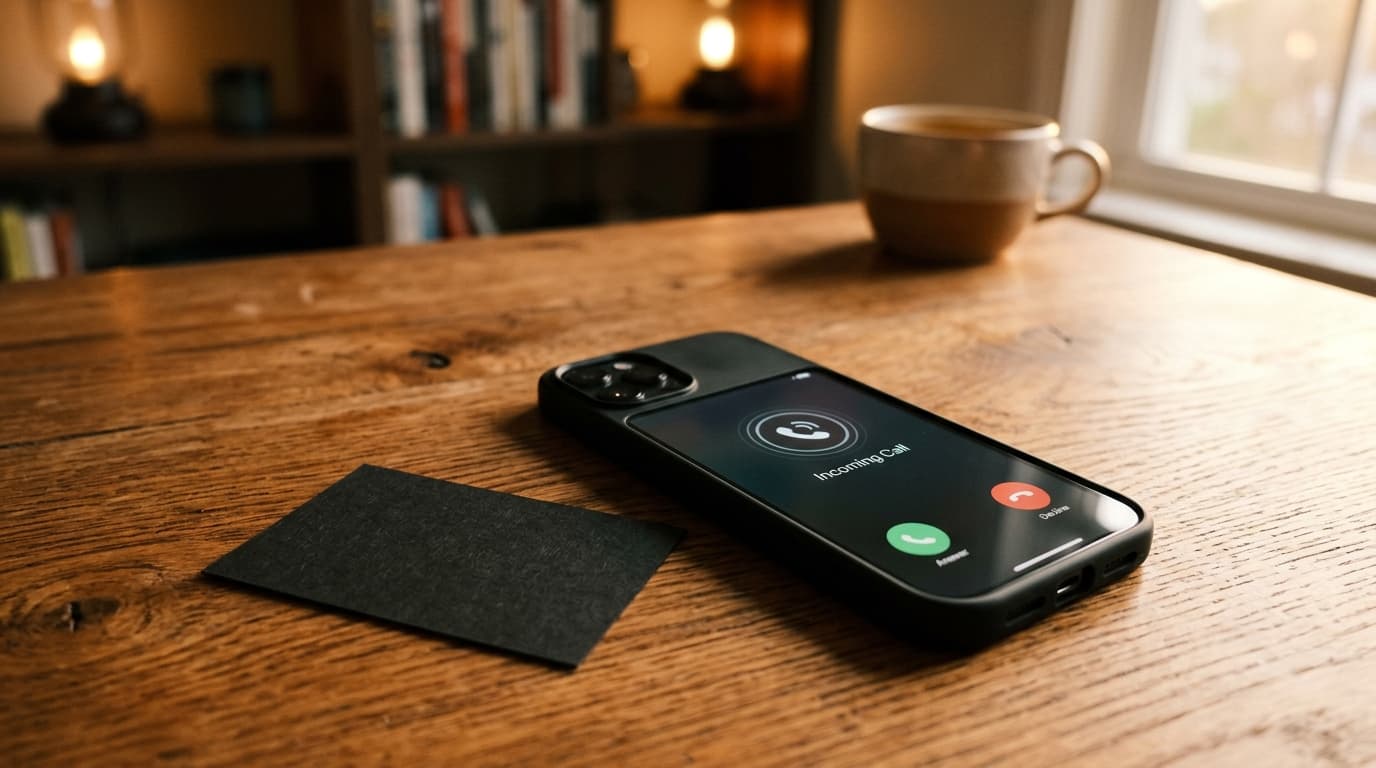
A fake adviser phones you in the name of your bank or Card Stop, announces suspicious operations and has you carry out the manipulations yourself with your own codes. The defence is a single gesture: hang up, then call back the number printed on the back of your card.
This page describes the Belgian scenarios recorded in 2026, how to recognise them and the first minutes after a mistake. Plain theft of a card is covered by another guide, on the lost or stolen card.
What does a fake bank adviser's call look like?
A call from a Belgian number, sometimes preceded by an automated message, announcing doubtful payments on your account. Febelfin describes this scenario in its warning of 23 May 2024: a voice presents itself as a Card Stop employee, mentions suspicious transactions, then asks for an unusual action to get at your personal data.
The hook varies from case to case. The four cases the Walloon Brabant prosecutor's office reported in late July 2026, according to L'Avenir of 1 August 2026 (French), each start from a different message.
| Date (2026) | Town | Hook | Fake caller | Outcome |
|---|---|---|---|---|
| 25 July | Ottignies-Louvain-la-Neuve | SMS about alleged Booking transactions | Belfius | The victim carries out operations with her codes, then a courier comes for her "blocked" cards |
| 27 July | Nivelles | SMS asking to update itsme data | Fake itsme app | Several operations by the victim, then withdrawals |
| 27 July | Tubize | Email announcing an Amazon Prime Video payment, link to a page asking for card number, expiry date and security code | BNP Paribas Fortis | The victim carries out operations to "counter fraud" |
| 28 July | Nivelles | SMS asking to call a number | Card Stop | The victim carries out operations to "avoid fraud" |
The article gives no total number of complaints. It states that each victim lost several thousand euros.
Why do these calls work even on careful people?
Because the fraudster arrives with true information: your name, sometimes your card number, collected earlier by a fake SMS or email. The Tubize case illustrates it. The victim had already entered card data on a fake page when the "bank agent" called.
The same pattern runs through the digital identity app. Test-Achats describes, in its article of 12 March 2026 (French), an SMS announcing an itsme account blocked after a fraud attempt. The link leads to a fake page where you enter your itsme PIN, digipass code or card data. If the banking app is linked to itsme, the fraudsters can then act in your name. Some SMS carry a familiar sender number, such as 8850.
The Walloon Brabant prosecutor's office sums it up: "Personne n'est à l'abri de ces fraudes" (nobody is immune to these frauds). I agree with the sentence, with a nuance from Febelfin's online-fraud brochure: 2% of respondents would share their bank codes without hesitation, and 5% of 16 to 30 year-olds without checking. A minority therefore falls at once, and the others give way under urgency.
A single signal is enough to hang up
Febelfin's advice (23 May 2024) and the Walloon Brabant prosecutor's (2026) overlap. A genuine bank does none of the following:
- phone on its own initiative to announce fraudulent operations (nor does Card Stop);
- ask for your PIN or other bank codes, by phone, link or SMS;
- have you use your card reader, or an identifier such as itsme, to confirm a payment or cancel a fraudulent transaction;
- ask you to carry out live operations while you stay on the line;
- send an SMS about updating the app, or settle an incident by phone;
- send a courier to collect your card.
Having cross-checked these sources, I hold a single one of these signals to be enough. Waiting for a second lets the fraudster build trust. The prosecutor recommends never calling the number in a suspicious message and using the official app of the bank, Card Stop or itsme.
What to do in the first minutes after giving in?
Act in this order, without trying to understand first.
- Call 078 170 170 (from abroad: +32 78 170 170). Since 22 June 2026 this number is also Fraudstop and blocks access to your online banking, in addition to cards. Febelfin counted more than 6,700 calls under it in the first month, about 200 a day (Febelfin, French).
- Contact your bank, which has an anti-fraud service reachable at all times, according to Febelfin.
- Block your itsme account from the itsme site, if the app was used (step cited by Test-Achats).
- Take screenshots of the SMS, emails and calling numbers, and note the time of the operations.
- File a report with the local police. For a suspicious QR code, the federal police also asks you to forward it to suspect@safeonweb.be.
- Ask your bank for a refund in writing, keeping proof of sending.
Details on the 50 euro excess and the legal regime are in our security pillar on credit card security. If the fraud touched an online purchase, the chargeback route is handled separately.
Must the bank refund when the victim validates?
Not automatically, and this is the hardest point of the file. Our security pillar explains that articles VII.38 to VII.45 of the Code of Economic Law, which cap the loss at 50 euros before notification and at zero after, do not cover frauds where the victim transfers the money personally. The fake adviser falls in that category: you press the button.
Test-Achats adds that banks often invoke "gross negligence" to refuse, and that this refusal cannot always be challenged. I found no public scale saying from which behaviour negligence is held, and I will not pretend to set one.
The rest of the procedure is known: written complaint to the bank, then Ombudsfin. The mediation figures call for caution. According to Financité's September 2025 brochure (French), 82% of 2024 cases ended positively, but only 37.5% in phishing, against 98% for other disputes. The filing steps are in our guide to the Ombudsfin complaint.
The trap does not stop at an emptied account
Not always. Ombudsfin published its 2025 annual report on 11 May 2026, and BX1 (French) relays several figures that I quote as given, without having read the report itself: 8,686 requests, of which 2,422 admissible, and 794 fraud files closed, 46 of them concerning fraudulent credits.
The scheme described is this: intercepted data is used to open a credit in the victim's name, then goods, mostly phones, are bought online. Complaints against credit companies rose to 221 (9% of the total), against 125 in 2024. BX1 also reports a rise in classic fraud of 72% over the last four months of 2025 and of 102% in the first quarter of 2026.
Practical consequence: after a fake call, do not just look at the account balance. Watch mail from credit companies and your statements for several months. The withdrawal periods for a credit, useful if you discover a contract you knew nothing about, are detailed in the guide to the credit withdrawal period.
How to protect yourself before the call?
The strongest protection is a habit: never act on an incoming call or message, and call back yourself. The Comines-Warneton local police relayed in August 2025 a Safeonweb alert on the SMS "Bonjour, vous êtes chez vous ?" (are you at home?), whose answer opens a fake delivery file and then a fake carrier site. The hook SMS has nothing banking about it, and I read it as a way of spotting an active number.
A few concrete measures:
- save 078 170 170 and your bank's number, found on the back of the card, in your phone so you can call back without searching;
- open the official app rather than a link, whoever the sender;
- agree a verification phrase within the family, especially for elderly relatives;
- when in doubt, talk to someone before acting, since the fraudster's pressure relies on the one-to-one.
The cardholder's rights and remedies are listed in the pillar on cardholder rights. The vocabulary of fraud (phishing, smishing, vishing, spoofing) is explained in the security glossary.
On 28 October 2026, I found no public source quantifying the number of fake-adviser victims in Belgium for the current year: the figures available are Ombudsfin's for 2025 and the local cases of July 2026.
Comparator Guides & Advice
Compare side by side.
Compare now →
Frequently asked questions
Keep reading
Sophie L. worked eight years in a Belgian bank branch, first as a credit adviser and then in customer relations, before going independent in 2021 and settling in Louvain-la-Neuve. Her work starts with the issuers' official fee schedules, from the high-street banks (ING, BNP Paribas Fortis, KBC, Belfius) to the neobanks (Revolut, N26, Wise), reduced to five comparable lines: annual fee, currency conversion charge, borrowing rate, spending limits and bundled insurance. Every price on this site carries the date it was checked: the annual-fee grid was gone through line by line on 12 August 2026, after Belfius moved its Beats Star package to 5.90 € a month in February. If an issuer does not publish a figure, she writes that down instead of estimating it. For readers who moved to Belgium, she spells out what a Belgian issuer expects from an applicant with no local credit history.