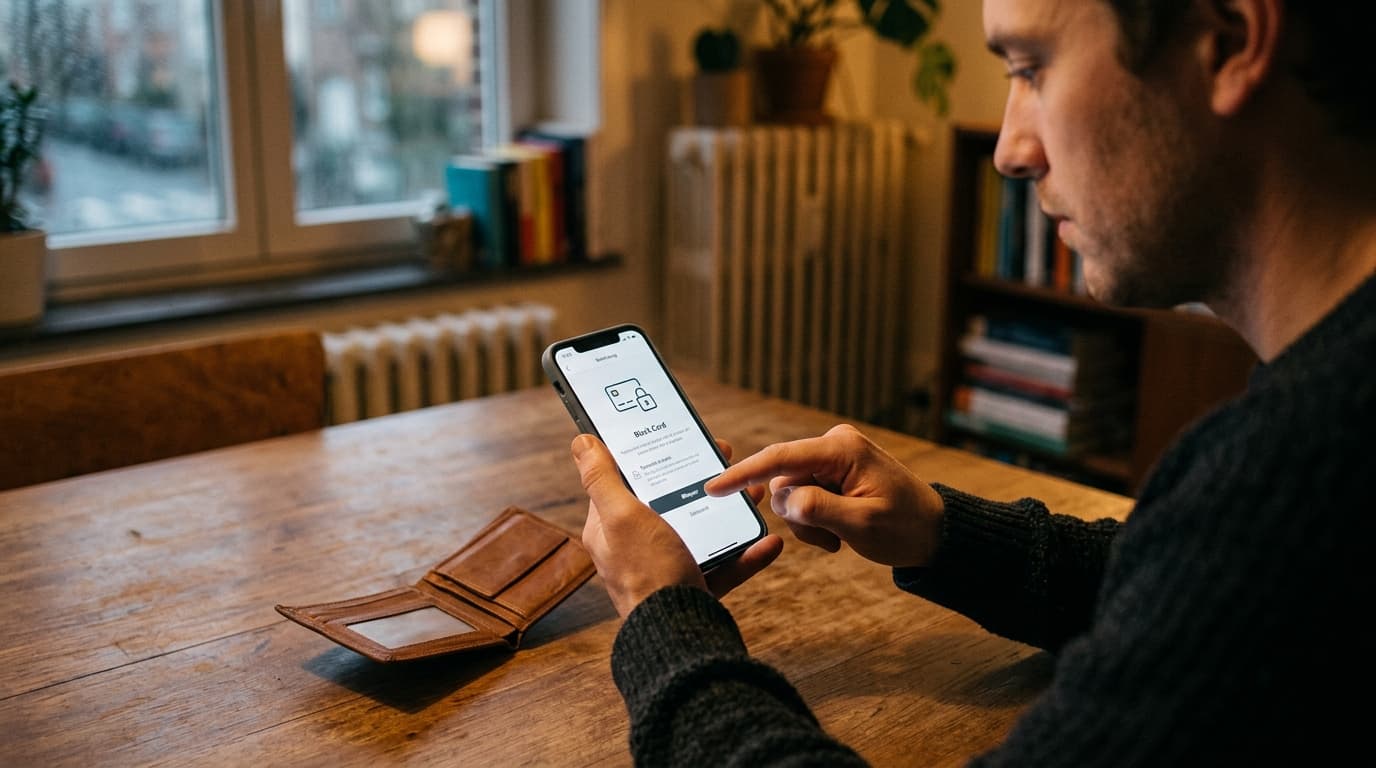
The number is 078 170 170. That is Card Stop, reachable around the clock at a standard call rate, and one call blocks every card issued in Belgium in your name: Visa, Mastercard and Bancontact, the Belgian domestic debit scheme. From abroad, dial +32 78 170 170. Call first. Read the rest afterwards.
Worldline, which runs the service for some 19 million Belgian cards, logged 775,362 calls in 2023, a fifth fewer than in 2022. Six calls in ten came from a mislaid card, a quarter from online fraud, the rest from theft. The blocking step is identical in all three cases. What differs comes later, when you have to prove something to somebody.
What should you do in the next fifteen minutes?
Pick up your phone before you search your pockets a second time. The order of the steps matters as much as the speed.
- Call Card Stop on 078 170 170. The operator asks for your name, date of birth and bank. Never your PIN. The block takes effect during the call, and you come away with a case number. Since 22 June 2026 the same number also serves as Fraudstop and blocks access to your online banking, not just the card: Febelfin, the federation of Belgian banks, recorded more than 6,700 calls on that basis in the first month, roughly 200 a day.
- Block inside your banking app as well. Two minutes of tapping, and the contactless tap closes while you wait on the line. That block stays reversible.
- Reread the last 48 hours of your account. Hunt for small amounts. Below 50 EUR a contactless payment goes through with no PIN, and that is where a thief almost always tests a card before moving up.
- Dispute the debits with your bank, in writing. Phone or app chat to move fast, then a written message that leaves a trail, or registered post if the sum is heavy. Attach the Card Stop case number and the list of transactions with amounts and times. The bank opens a dispute file and triggers a chargeback with Visa or Mastercard where the transaction allows it.
- File a report at your local police station. Bring your identity card or residence permit, the Card Stop case number and a printed list of the disputed debits. The report is not a legal condition for reimbursement, and a bank that tells you otherwise is wrong. It still helps: the police record dates the events and carries weight if the file ends up with the financial ombudsman.
| Bank | Block via app | Unblock possible | Permanent block via app |
|---|---|---|---|
| ING | Yes | Yes | No — Card Stop |
| BNP Paribas Fortis | Yes | Yes | No, Card Stop |
| KBC | Yes | Yes | No, Card Stop |
| Belfius | Yes | Yes | No, Card Stop |
| Beobank | Yes | No | No, Card Stop |
| Argenta | Yes | Yes | No, Card Stop |
On the order between the app and the phone call, I part ways with the standard advice. The usual line is to block in the app first, since it can be undone, and only ring Card Stop once the doubt is confirmed. I do the opposite, and I accept how uncomfortable that is: an in-app block is a technical command you operate yourself, whereas the shift of liability organised by Book VII of the Belgian Code of Economic Law is triggered by notification to the card issuer. I have found no published Belgian ruling that settles whether a button inside an app counts as notification within the meaning of the Code. While that stays unclear, three minutes on the phone end the argument.
My advice has a real cost, and I would rather write it down: if the card turns up that same evening in your coat lining, it is dead anyway.
A week, sometimes two, before you can pay normally again
Once the block is done, you need a piece of plastic that works.
- Order the replacement card during the call to your bank, without waiting for a confirmation letter. In most cases the order leaves the same day.
- Ask whether a provisional card is available at a branch. KBC, Belfius and Crelan issue one on the spot, the others do not.
- Reopen your digital wallets. If you had set up Apple Pay or Google Pay before the loss, the virtual card stays usable on your phone as long as the physical number is not permanently blocked, and you will attach the new card to the wallet as soon as it arrives.
- Use the replacement to bring your ceilings down. A card allowing 5,000 EUR of monthly payments when you spend 1,000 exposes you four times over, and most apps change those limits in seconds.
| Bank | Replacement cost | Delivery time | Temporary card at branch |
|---|---|---|---|
| ING | 5 – 10 EUR | 7 – 10 days | No |
| BNP Paribas Fortis | 7 – 12 EUR | 5 – 8 days | No |
| KBC | 5 – 10 EUR | 5 – 7 days | Yes (provisional card) |
| Belfius | 5 – 10 EUR | 5 – 10 days | Yes (provisional card) |
| Beobank | 5 EUR | 7 – 10 days | No |
| Argenta | 5 – 10 EUR | 7 – 10 days | No |
| Keytrade Bank | 0 EUR | 7 – 10 days | No (online bank) |
| Crelan | 5 – 10 EUR | 7 – 10 days | Yes |
Three deliveries arrive separately: the card, then the PIN two or three days later in a second envelope, then the replacement fee on the monthly statement. Splitting the post stops anyone intercepting your letterbox from holding both the plastic and the code. At KBC and Belfius you can pick a new PIN yourself in the app once the physical card is in your hand.
Nothing after ten business days? Ask again in writing, and have the date of your first request put on record. You pay an annual fee for a working means of payment, and that argument can be made.
Who pays for the fraudulent payments made before your call?
Book VII of the Code of Economic Law answers, article by article.
Article VII.44 of the Code of Economic Law, the Belgian statute transposing the EU payment services directive PSD2, caps your share at 50 EUR for unauthorised transactions made before notification. A thief who spends 500 EUR contactless while you look for your phone costs you 50 EUR. After notification that cap drops to zero and the bank carries the whole amount. For the mechanics of the dispute itself, our chargeback guide for Belgium sets out the admissible grounds.
Those 50 EUR can fall away too. If an online payment went through without strong authentication (3D Secure, Visa Secure, Mastercard Identity Check), the loss sits with the bank or the merchant. And if your issuer never gave you a way to report the loss, it cannot claim anything from you.
The exception behind most disputes has a name: gross negligence. The PIN written on the card, a 1234 code, credentials handed over on the phone to a stranger. Refusal letters rarely mention this point: Wikifin, the financial education site run by the Belgian market regulator FSMA, states that the burden of proof falls on the issuer. You do not have to demonstrate your caution; the bank has to demonstrate your carelessness, and falling for a fake text message does not get it there.
Then comes the calendar. You have 13 months from the debit date to report an unauthorised transaction, under Article VII.41. The bank, for its part, must refund by the end of the first business day following your dispute. That deadline is little known and even less respected: many institutions wait for their internal investigation to close before crediting the account, whereas the text provides for an immediate refund, with the option of taking the money back if the investigation goes against you. Put the words "business day" in writing. It often changes the tone of the reply.
Then there is the case where the bank says no. Go through its complaints department first, which is a mandatory step. Only then refer the matter to Ombudsfin, the Belgian ombudsman for financial services, at Avenue du Roi Albert II 8, 1000 Brussels. The procedure is free, entirely written, and usually takes 90 days from a complete file.
Amounts, deadlines and numbers in this article checked on 19 August 2026 against the sources cited.
Outside Belgium, the order of the steps changes
Far from home, blocking is no longer enough: you also need something to pay tonight's hotel with.
- Dial +32 78 170 170. The line answers from any country. With no mobile signal, hotel WiFi and your banking app are enough for a temporary block while you wait to get through.
- File a report with the local police the same day, passport in hand. Ask for a written copy carrying the report number. Translate it only if your Belgian bank explicitly asks, once you are back.
- Rebuild a means of payment. An emergency transfer from your bank to a local Western Union or MoneyGram counter, a Bancontact debit card kept somewhere other than the stolen wallet, a wallet still live on your phone.
- As a last resort only, approach the Belgian consular post for emergency assistance. If you are an expat holding another nationality, your own consulate applies instead.
A Gold or Platinum card often opens an extra channel: a cash advance, express shipping of a replacement card, sometimes repatriation. Terms vary so widely between issuers that the detour through our credit card insurance comparison belongs before departure, not in a hotel room in Lisbon. Same logic for choosing the card if you travel outside the eurozone: our guide to travel-friendly cards compares the fee grids.
What shrinks the bill is decided before the theft, not during. Keep credit card and debit card in two different places, so a stolen wallet never leaves you with nothing. Turn on payment notifications: they warn you within seconds, long before the monthly statement. Photograph the front of your card with the eight middle digits masked. And save 078 170 170 in your contacts under "Card Stop", because hunting for a number while panicking costs minutes, and those minutes carry a published price of 50 EUR.
That number has not changed since 10 January 2022. There is only one.
Comparator Guides & Advice
Compare side by side.
Compare now →
Frequently asked questions
Keep reading
Sophie L. worked eight years in a Belgian bank branch, first as a credit adviser and then in customer relations, before going independent in 2021 and settling in Louvain-la-Neuve. Her work starts with the issuers' official fee schedules, from the high-street banks (ING, BNP Paribas Fortis, KBC, Belfius) to the neobanks (Revolut, N26, Wise), reduced to five comparable lines: annual fee, currency conversion charge, borrowing rate, spending limits and bundled insurance. Every price on this site carries the date it was checked: the annual-fee grid was gone through line by line on 12 August 2026, after Belfius moved its Beats Star package to 5.90 € a month in February. If an issuer does not publish a figure, she writes that down instead of estimating it. For readers who moved to Belgium, she spells out what a Belgian issuer expects from an applicant with no local credit history.