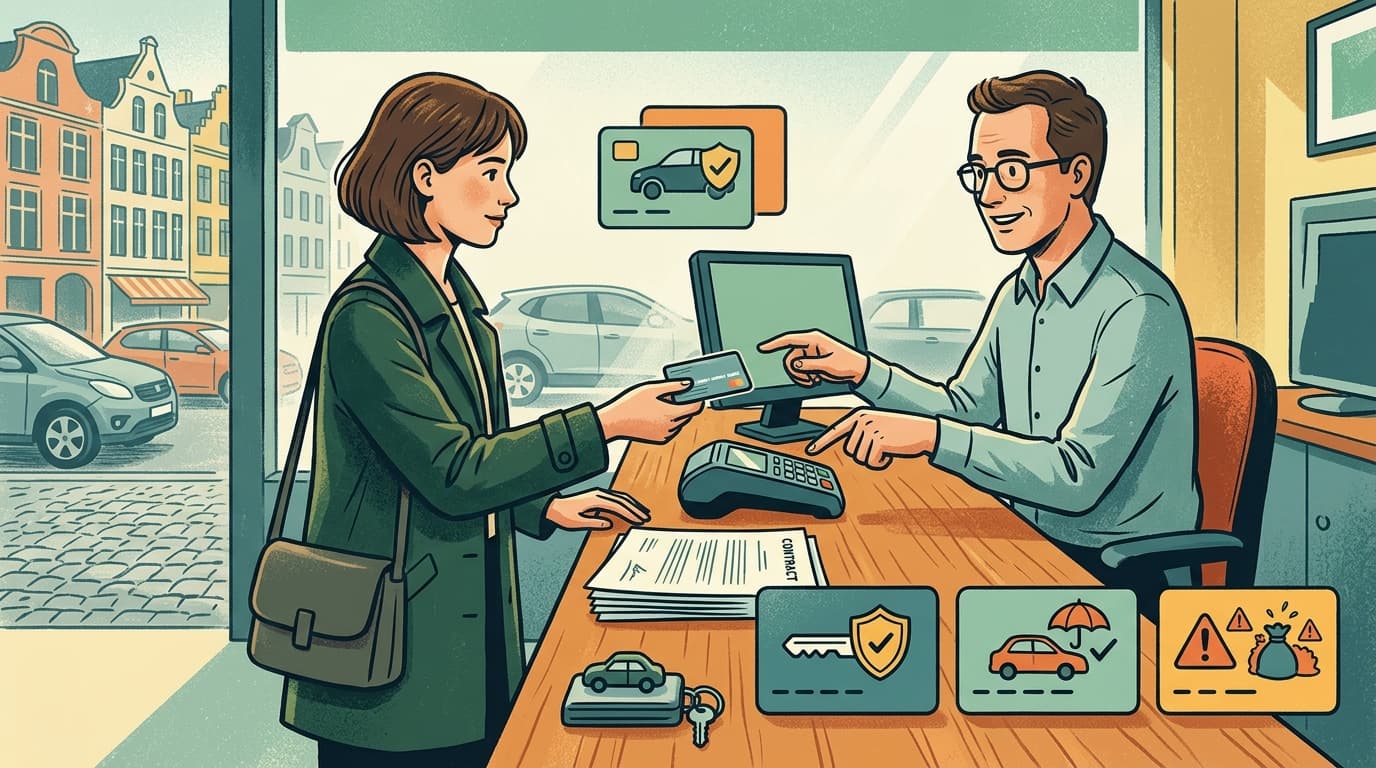
Renting a car in Belgium — or from Belgium abroad — almost always requires a credit card. Not a debit card, not Bancontact, not a bank transfer: a Visa or Mastercard credit card in the driver's name. It's the guarantee that almost all rental companies require for the deposit, that security hold that blocks EUR 300 to 3,000 on your card during and after the rental.
This guide explains why it's mandatory, how it compares in cost to rental company insurance, and which Belgian card to choose based on how often you rent.
Why do rental companies require a credit card?
The reason is financial, not commercial. A credit card lets the rental company block an amount (the pre-authorisation) without charging the customer's account. This hold serves as a guarantee against damage, theft, traffic fines, or missing fuel. With a debit card, the amount is directly debited from the current account — which rental companies consider too risky if the balance is insufficient.
In practice, the five major rental companies operating in Belgium (Europcar, Hertz, Avis, Sixt, Enterprise) all require a Visa or Mastercard (credit only). Notable exception: Hertz has accepted Debit Mastercard in Belgium since July 2019, though not Maestro or Bancontact. American Express is accepted by Hertz, Avis, and Europcar for payment, but not always for the deposit. Bancontact and Maestro are never accepted as a guarantee by any rental company.
The card must be in the main driver's name. A spouse or colleague cannot provide their card for another driver — this rule is systematic and without exception at major rental companies.
How much deposit does the rental company block?
The pre-authorisation amount depends on the vehicle category and the insurance coverage chosen.
| Category | Typical deposit (basic CDW) | Deposit with Super CDW (reduced excess) |
|---|---|---|
| City car (Fiat 500, VW Polo) | EUR 300 – 1,200 | EUR 100 – 300 |
| Saloon (VW Golf, Peugeot 308) | EUR 800 – 1,500 | EUR 200 – 400 |
| SUV (Peugeot 3008, VW Tiguan) | EUR 1,000 – 2,000 | EUR 300 – 500 |
| Van / premium | EUR 1,500 – 3,000 | EUR 400 – 600 |
The gaps between companies are significant. Europcar blocks around EUR 300 for a city car (Belgium terms and conditions, October 2025). Hertz can go up to EUR 3,000 for a premium vehicle.
The pre-authorisation is not a charge: the money is blocked, not debited. Your bank balance doesn't change, but your available credit limit decreases by the blocked amount. If your card has a EUR 2,500 limit and the rental company blocks EUR 1,200, you can only spend EUR 1,300 more on that card.
The release timeframe is the sensitive point. After return without damage, the pre-authorisation is lifted within 2 to 4 weeks depending on the rental company and your bank. At Sixt, it's often faster (7 to 15 business days). At Hertz, expect up to 30 days. This delay depends primarily on your issuing bank, not the Visa or Mastercard network.
Which Belgian credit card for renting a car?
For car rental, two criteria matter: the credit limit (sufficient to absorb the deposit) and complementary CDW insurance (to avoid the rental company's Super CDW).
| Bank | Card | Annual cost | CDW insurance | Excess reimbursed | Typical limit |
|---|---|---|---|---|---|
| Belfius | Gold | EUR 50 | Yes | Rental vehicle excess | EUR 2,500 – 5,000 |
| ING | Gold | EUR 51 | Yes (travel insurance) | Subject to conditions | EUR 2,500 – 5,000 |
| KBC | Credit card + Travel Package | EUR 72 (KBC Plus) + EUR 7/month (Travel) | Optional | Up to EUR 2,500/claim | EUR 2,500 – 7,500 |
| BNP Paribas Fortis | Visa/MC Classic | EUR 27 | No | — | EUR 1,250 – 5,000 |
| Beobank | Visa Classic | EUR 5 | No | — | EUR 1,250 – 2,500 |
| Argenta | Mastercard | EUR 24 | No | — | EUR 1,250 – 2,500 |
KBC replaced its Gold cards with a single credit card in 2025. The Travel Package (EUR 7/month add-on) reimburses the rental company's excess up to EUR 2,500 per claim. Belfius Gold includes a rental vehicle excess exemption. ING Mastercard Gold offers travel insurance that covers rental vehicle damage under certain conditions. For Belfius and ING: the rental must be paid with the Gold card, and you must decline the rental company's Super CDW. The maximum covered duration is generally 31 consecutive days of rental.
Classic cards (BNP, Beobank, Argenta) work for the deposit but include no rental insurance. They're sufficient if you accept the rental company's basic CDW and are prepared to pay the excess in the event of a claim. For a full comparison of Gold cards, see our Gold and Platinum card guide for Belgium.
Debit card, Revolut, or N26: do they work?
Revolut, N26, Wise, and Bunq cards are debit cards, not credit cards. Even though they carry the Visa or Mastercard logo, they don't support pre-authorisation in the traditional banking sense.
In practice, acceptance varies by rental company and location. Some Sixt or Europcar counters accept Revolut if the balance is sufficient. Others categorically refuse any debit card. The policy shown on the rental company's website doesn't always match reality at the counter — which creates unpleasant situations at the airport.
Three common problems with neobank cards:
- Extended hold: the pre-authorisation can remain blocked for 30 days on a Revolut balance, compared to 14 days on a traditional card. During this time, the money is unavailable.
- Insufficient balance: if you have EUR 1,500 in your Revolut account and the rental company requires a EUR 1,200 deposit, you're left with just EUR 300 for the rest of your trip.
- Counter refusal: the rental company's terminal may identify the card as a debit card and refuse it, even if the balance is sufficient. No recourse possible on site.
The reliable strategy: use a classic Belgian credit card (even a Classic at EUR 5/year from Beobank) for the deposit, and pay for the rental with your neobank card if you want to avoid foreign exchange fees abroad.
How to avoid the Super CDW at the counter?
The Super CDW — also called SCDW, "excess waiver" or "franchise reduction" — is the rental company's biggest revenue source after the rental price itself. It costs EUR 10 to 25 per day depending on the company and vehicle category. Over a week, that's EUR 70 to 175.
Its purpose: reduce your excess to EUR 0 in the event of damage. Without Super CDW, you pay the standard excess (EUR 500 to 1,200) if the vehicle is damaged.
Three strategies to avoid this cost:
1. Gold card with complementary CDW insurance. This is the most cost-effective solution for Belgians who rent at least once a year. The card's insurance reimburses the rental company's excess after the fact. You pay the excess first, then your bank reimburses you upon filing a claim. Reimbursement timeframe: 15 to 30 days depending on the bank. Cost: EUR 0 extra (included in the Gold card fee).
2. Independent rental insurance. Insurers like iCarhire or Worldwideinsure offer annual policies (EUR 50 to 80/year) or one-off coverage (EUR 6 to 10/day) that cover the rental company's excess. Useful if you don't want a Gold card.
3. Accept the risk. If you're renting a city car for a weekend in Belgium, the probability of damage is low. The basic CDW excess (EUR 500 to 800 for a city car) remains a manageable risk.
What to check before signing the contract?
The rental counter is a high-pressure sales environment. Staff systematically offer additional insurance and options. Four points to check before signing.
Vehicle condition. Take photos (phone with timestamp) of every scratch, dent, and chip before leaving the car park. Report any defect on the departure form. Post-return disputes are almost always about pre-existing damage that wasn't documented.
Fuel level. Choose the "full/full" option: you take the vehicle with a full tank and return it full. The rental company's "prepaid fuel" option costs 15 to 30% more than the pump price.
Actual excess. Ask for the exact excess amount stated in the contract. It may differ from the amount shown during online booking, especially if you change vehicle category at the counter.
Additional driver. Each additional driver costs EUR 5 to 15 per day. They must present their licence and be listed on the contract. An undeclared driver voids all insurance in the event of an accident.
What to do in case of a dispute after returning the car?
If the rental company charges your card after return (disputed damage, cleaning fees, fuel), you have several options.
First contact the rental company's customer service in writing. Send your photos of the vehicle's condition at departure and return. Most disputes are resolved at this stage if the evidence is clear.
If the rental company refuses to refund, initiate a chargeback through your bank. Visa and Mastercard allow 120 days to dispute a charge. Your bank will request supporting documents (contract, photos, correspondence with the rental company) and forward the dispute to the network.
For rental companies operating in the EU, the European Consumer Centre (CEC Belgium) assists Belgian consumers free of charge in cross-border disputes.
As a last resort, file with the justice of the peace in the location of the rental (competent for amounts up to EUR 5,000). The filing fee is EUR 50. Above EUR 5,000, the case goes to the court of first instance (EUR 165 filing fee).
FAQ
Answers to the most frequently asked questions about cards and car rental in Belgium appear in the FAQ section at the top of this article. Each answer covers a specific case: renting without a card, deposit amounts, neobanks, CDW insurance, card selection, post-return disputes, impact on your limit, and the main driver rule.

Comparator Guides & Advice
Compare side by side.
Compare now →
Frequently asked questions
Keep reading
Sophie L. worked eight years in a Belgian bank branch, first as a credit adviser and then in customer relations, before going independent in 2021 and settling in Louvain-la-Neuve. Her work starts with the issuers' official fee schedules, from the high-street banks (ING, BNP Paribas Fortis, KBC, Belfius) to the neobanks (Revolut, N26, Wise), reduced to five comparable lines: annual fee, currency conversion charge, borrowing rate, spending limits and bundled insurance. Every price on this site carries the date it was checked: the annual-fee grid was gone through line by line on 12 August 2026, after Belfius moved its Beats Star package to 5.90 € a month in February. If an issuer does not publish a figure, she writes that down instead of estimating it. For readers who moved to Belgium, she spells out what a Belgian issuer expects from an applicant with no local credit history.