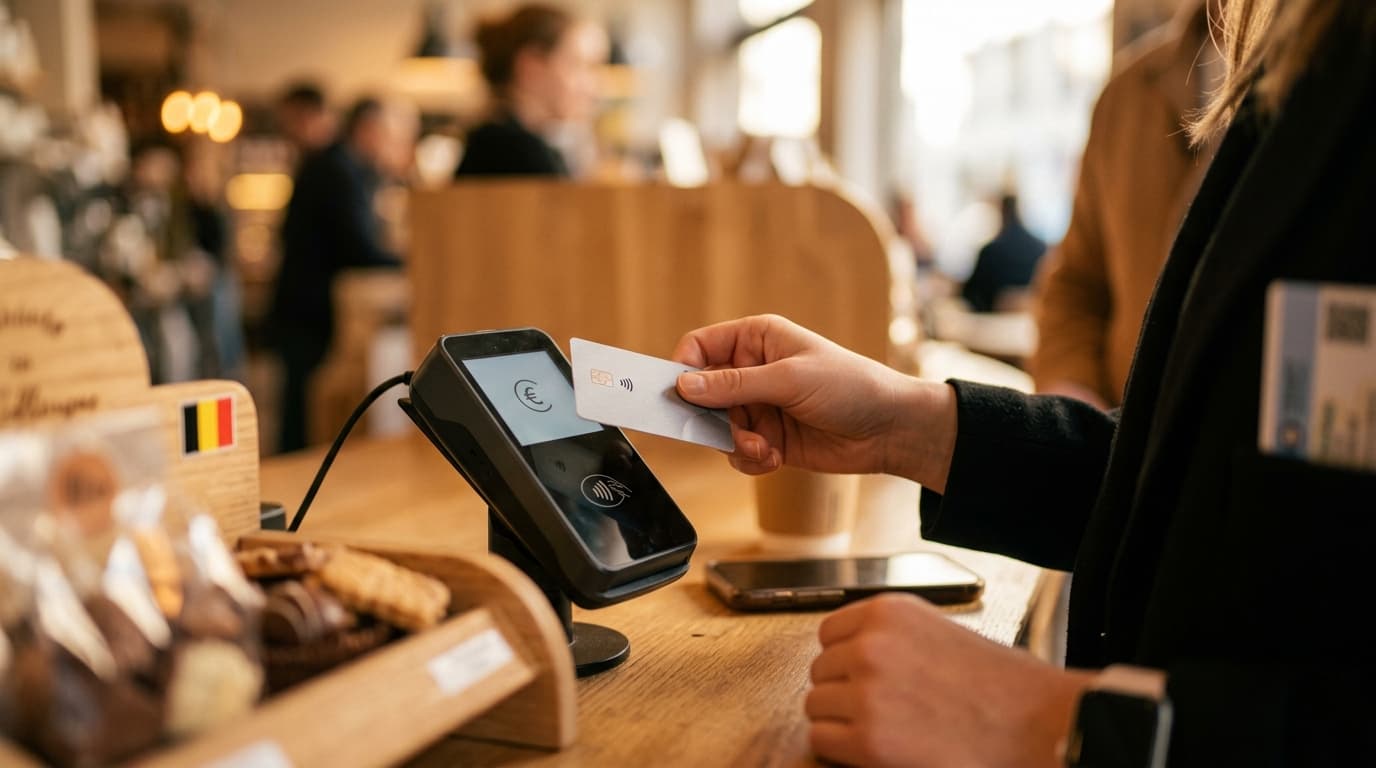
Tap the card on the terminal, pay in one second, walk away. Contactless payment has become the norm in Belgium: in 2024, 1.35 billion Bancontact in-store transactions were made by simple NFC tap, representing over 71% of point-of-sale payments. Credit cards follow the same trend — every Visa and Mastercard issued in Belgium now includes a contactless chip. What remains is understanding the actual limits, real-world security, and uses many people still overlook, from smartphones to public transport.
How does contactless payment work?
NFC (Near Field Communication) technology transmits payment data between your card and the terminal over a distance of less than 4 centimetres. Each transaction generates a unique cryptogram — even if intercepted, it cannot be used for a second payment.
In practice, two modes coexist. Card mode: you hold your Bancontact, Visa or Mastercard card near the terminal. Mobile mode: you use Apple Pay, Google Pay or Samsung Pay on your smartphone or smartwatch. In both cases, the transaction takes less than two seconds.
The key difference between card and mobile lies in authentication. The physical card relies on NFC alone for small amounts (up to 50 euros). The smartphone systematically requires biometric verification (Face ID, fingerprint) or a code, which removes the 50-euro cap — you can pay 200 euros via Apple Pay without entering a PIN.
What is the contactless limit in Belgium?
The per-transaction limit is 50 euros. This threshold was doubled in April 2020 during the pandemic (from 25 to 50 euros) and has remained in place since.
Beyond the per-transaction limit, a cumulative cap applies. After 100 to 150 euros of consecutive contactless payments (the amount varies by bank), the terminal requests the PIN code. This mechanism is mandated by the European PSD2 directive to limit risk in case of card theft.
| Bank | Per-transaction limit | Cumulative limit | Adjustable via app |
|---|---|---|---|
| Belfius | €50 | €100 | Yes, up to €125 |
| KBC / CBC | €50 | €150 | Yes |
| ING | €50 | €100 | Yes |
| BNP Paribas Fortis | €50 | €100 | Yes |
| Argenta | €50 | €100 | No |
| Beobank | €50 | €100 | Yes |
At Belfius, KBC and ING, you can adjust your cumulative limit directly in the mobile app — a useful option if you chain small purchases during grocery shopping or while travelling.
Credit card or Bancontact: which one for contactless?
Both work identically at the terminal — same gesture, same speed. The difference is financial. With Bancontact, the amount is debited immediately from your current account. With a Visa or Mastercard credit card, the debit occurs at the end of the month or according to your billing cycle.
For purchases abroad, the credit card has the advantage. Bancontact remains a Belgian network: outside Belgium, your card switches to the Maestro or Debit Mastercard network, sometimes with fees. A contactless Visa or Mastercard works worldwide without this constraint.
Contactless credit card payments also offer chargeback protection — a safeguard absent from Bancontact payments. If a merchant fails to deliver, you can dispute the payment through Visa or Mastercard within 120 days.
How to pay contactless on Belgian public transport?
Brussels led the way. STIB accepts contactless payment across its entire network — buses, trams and metro. A single trip costs 2.40 euros, connections within 60 minutes are free, and daily spending is capped at 8.50 euros. You tap your card or smartphone on the validator when boarding.
De Lijn (Flanders) and TEC (Wallonia) are progressively equipping their vehicles with NFC validators. TEC simplified its fare structure in February 2026 with a single "Classic" ticket valid for 90 minutes across the entire network.
SNCB reformed its ticketing in October 2025 with distance-based pricing and automatic best-fare selection. NFC-enabled cards are accepted at ticket machines and counters.
Is contactless payment safe?
This question comes up often, and the answer is clear: contactless is one of the safest payment methods available. Febelfin, the Belgian banking federation, has not recorded a single confirmed case of NFC capture fraud in Belgium — those stories about rogue terminals in the metro are urban myths.
Three protection mechanisms stack on top of each other. The 50-euro cap limits exposure in case of theft. The PIN code is required after 100 to 150 euros cumulative. And tokenisation (for mobile payments) replaces your card number with a unique token for each transaction.
In case of theft or loss, block your card immediately via Card Stop (078 170 170, available 24/7). Contactless payments made before blocking are covered by a maximum liability of 50 euros — beyond that, the bank reimburses in full, as required by the PSD2 directive transposed into Belgian economic law.
Paying contactless with a watch or wearable
Wrist payment works in Belgium via Apple Watch (Apple Pay), Samsung Galaxy Watch (Google Pay or Samsung Pay) and compatible Garmin or Fitbit watches. The principle is the same as with a smartphone: hold your wrist near the terminal.
Setup involves adding your card to the watch's companion app. Garmin Pay and Fitbit Pay require a 4-digit PIN set during configuration — it is requested each time you put the watch back on your wrist. Card data is neither stored nor shared: only a tokenised token passes during payment.
Banks compatible with Apple Pay and Google Pay in Belgium support smartwatches without additional setup — if your card works on your smartphone, it will work on your watch. Neobanks like Revolut and N26 offer native compatibility with most wearables.
What about Wero?
Wero is a European instant payment system launched in Belgium in November 2024. KBC, CBC, Belfius, ING and BNP Paribas Fortis integrated it first. Five additional banks — Argenta, Beobank, Crelan, Bank Van Breda and vdk bank — are joining in the first half of 2026. Revolut announced Wero compatibility for its Belgian customers from July 2025.
For now, Wero primarily serves instant transfers between individuals (P2P). E-commerce payments have been active in Belgium since March 2026. In-store QR code payments are expected during 2026, and NFC tap-to-pay is planned for 2027.
Wero does not replace Bancontact in the short term. Both systems coexist, and Bancontact remains the de facto standard for in-store payments with 1.9 billion card transactions in 2024. Wero aims to create a European alternative to Visa and Mastercard networks for account-to-account payments.
FAQ
Answers to the most common questions about contactless payment in Belgium.
Comparator Guides & Advice
Compare side by side.
Compare now →
Frequently asked questions
Keep reading
Sophie L. worked eight years in a Belgian bank branch, first as a credit adviser and then in customer relations, before going independent in 2021 and settling in Louvain-la-Neuve. Her work starts with the issuers' official fee schedules, from the high-street banks (ING, BNP Paribas Fortis, KBC, Belfius) to the neobanks (Revolut, N26, Wise), reduced to five comparable lines: annual fee, currency conversion charge, borrowing rate, spending limits and bundled insurance. Every price on this site carries the date it was checked: the annual-fee grid was gone through line by line on 12 August 2026, after Belfius moved its Beats Star package to 5.90 € a month in February. If an issuer does not publish a figure, she writes that down instead of estimating it. For readers who moved to Belgium, she spells out what a Belgian issuer expects from an applicant with no local credit history.