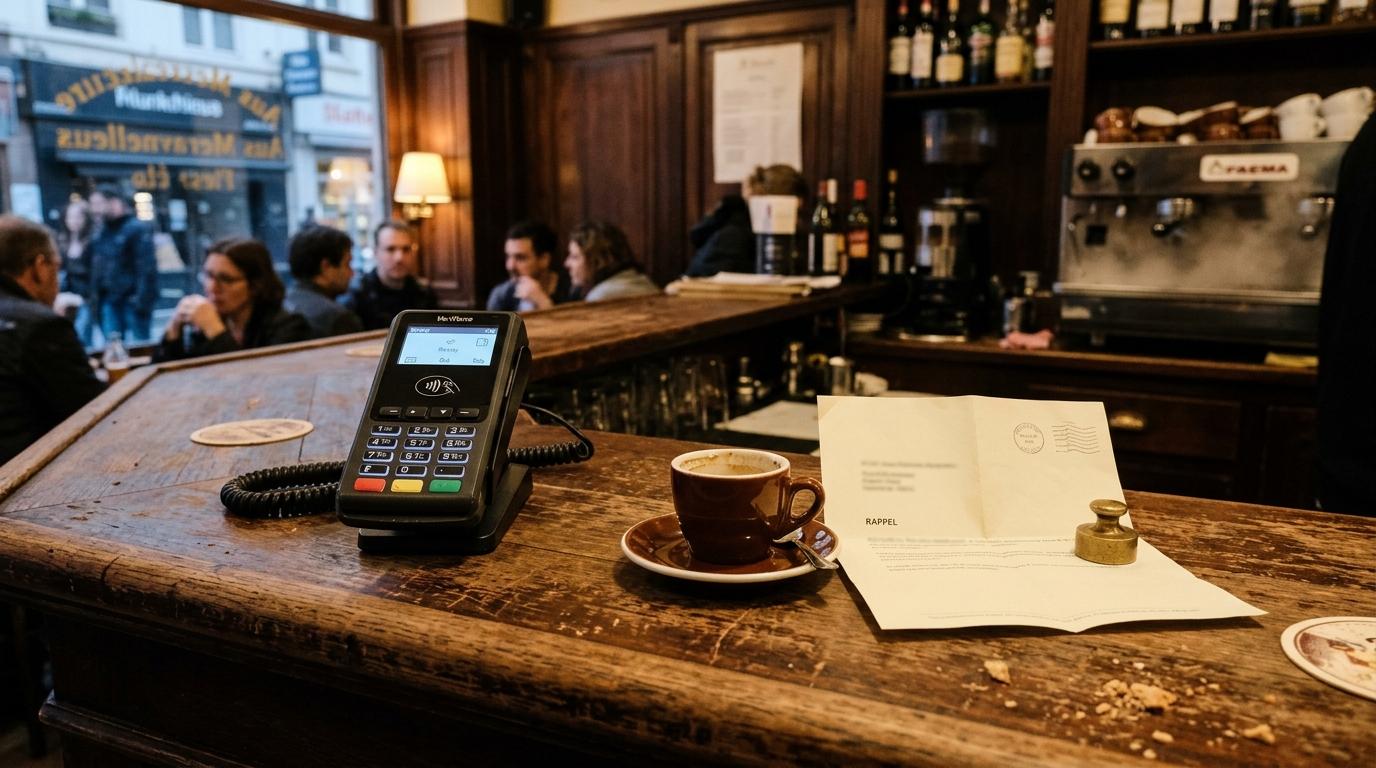
This article is being re-checked against official sources. The fees it quotes may be out of date: the reference figures are those of the comparator, read on the issuers’ pages on 19 November 2026.
A late payment on a credit card costs little at first: 7.50 euros per reminder, plus postage, and late interest at the borrowing rate multiplied by 1.10 (Beobank). Registration comes later, after two or three months unpaid depending on the source, and the record stays between one and ten years at the Credit Register (Centrale des crédits aux particuliers).
This page is about the card with spread repayment.
The deferred-debit card, charged in one go to the account, is another subject, explained in the pillar on how a credit card works.
What does a few days' delay cost?
At Beobank, the reminder costs 7.50 euros plus the postage of the day, at most one mailing a month. Late interest is added, calculated at the last borrowing rate "increased by a coefficient of 10%", which amounts to multiplying it by 1.10. It runs only on the overdue capital, not on the whole outstanding amount, according to the same document. This document, read on 9 November 2026, is marked "Simulation" and carries no date.
On the SECCI of the Beobank Young Mastercard, recorded on 30 September 2026 in our article on the forgotten PIN and the blocked card, the late-payment rate goes from 15.02% to 16.52%. Applied to 750 euros left unpaid for a month, that is about 10 euros of simple interest (my own calculation), plus the 7.50 euro reminder: under 20 euros, postage excluded.
That is little, and it is misleading, because the serious cost sits further along the calendar.
| Stage | Consequence | Source |
|---|---|---|
| First delay | Reminder at €7.50 plus postage, at most one a month; late interest at the borrowing rate × 1.10 | Beobank, undated document, read 9 Nov. 2026 |
| Two to three months without payment, depending on the source | Registration at the Credit Register possible; the Register informs the holder | Droits Quotidiens, 19 March 2026; Wikifin, 16 Feb. 2026 |
| Registered letter, then three months without regularisation | Termination possible: balance due, indemnity of 10% up to €7,500, 5% above | Test-Achats, 8 Sept. 2022; Beobank |
| Regularisation | Record kept one year | Wikifin; Droits Quotidiens |
| Default never regularised | Record kept up to ten years | Wikifin; Droits Quotidiens |
When can the bank terminate the card?
Not at the first delay. In an expert answer of 8 September 2022 (French), Test-Achats describes a first reminder, then a registered letter, then a possible termination if the arrears are not cleared within "the legal period of three months". The Beobank document says the same in its own words: late interest and indemnity fall due at the end of three months after a formal notice by registered letter.
Once the contract is terminated, the whole balance falls due at once, with an indemnity of 10% of the remaining capital up to 7,500 euros and 5% above, which is added to the late interest already accrued on the sums unpaid during the previous three months. The same scale appears in the Young Mastercard SECCI. On 750 euros remaining, the indemnity is 75 euros, ten times the reminder. If I had to watch a single figure, it would be that one, not the reminder.
In your contract or your SECCI, look for these four lines:
- the late-payment rate, worded as a borrowing rate plus a coefficient;
- the amount of the reminder and how often it is sent;
- the scale of the indemnity on termination;
- the period left after the formal notice before termination.
Book VII of the Code of Economic Law, which sets these periods, was not read: the Justice website refuses robots. The figures come from two Beobank documents, and I do not know whether ING, KBC, BNP Paribas Fortis or Belfius apply 10% and 5%.
Does a late payment get you into the Credit Register?
Not for a few days, but sources differ on the threshold. Droits Quotidiens (French, 19 March 2026) writes that you are registered "if you do not pay for at least 2 months"; our page on registration at the National Bank says three instalments or three months unpaid; Wikifin (French, 16 February 2026) gives no figure. I would take the shortest figure as the limit. The record lasts one year after regularisation, ten years at most without it, and a payment plan does not wipe it before full repayment.
A registered letter sent before the due date changes what follows
Wikifin (French, page of 9 February 2026) advises contacting the lender as soon as repayment becomes difficult. In order:
- Write to the issuer before the debit date and ask for a suspension of payments or a spreading; confirm any agreement by registered letter, as Wikifin asks.
- With no answer after one month, or after a refusal, the justice of the peace can grant a rescheduling of future instalments (Wikifin).
- With several creditors, or if talks fail, a recognised debt mediator (lawyer, notary, CPAS or approved non-profit) can negotiate a new plan.
I would start with the registered letter: an adviser's verbal promise appears in no file, and the day the issuer invokes the formal notice, only the letter exists. Test-Achats adds an uncomfortable fact: a lender that suspends instalments or lengthens the term may thereby create a new credit.
I would not take another credit to cover this one: Test-Achats speaks of "digging a hole to fill another".
Where to find help if the delay turns into debt?
Your municipality's CPAS (public social welfare centre) offers debt mediation (Wikifin, 11 May 2026, French), and collective debt settlement remains the last resort (Wikifin, 9 February 2026). Against the issuer itself: the Ombudsfin complaint guide and the pillar on cardholder rights.
Sources re-read on 9 November 2026: Wikifin pages of 9 February, 16 February and 11 May 2026, Droits Quotidiens of 19 March 2026, Test-Achats expert answer of 8 September 2022, undated Beobank document.
Comparator Guides & Advice
Compare side by side.
Compare now →
Frequently asked questions
Keep reading
The meilleure-carte-credit.be editorial team reproduces the fees issuers publish themselves: product pages, fee lists and fee information documents from Belgian banks (ING, BNP Paribas Fortis, KBC, Belfius, Beobank, Argenta, Keytrade Bank) and neobanks (Revolut, N26, bunq, Wise). Every figure links to its official source and carries the date we read it. When an issuer does not publish a figure, we say so instead of estimating it. Last full reading of the comparator: 19 November 2026.