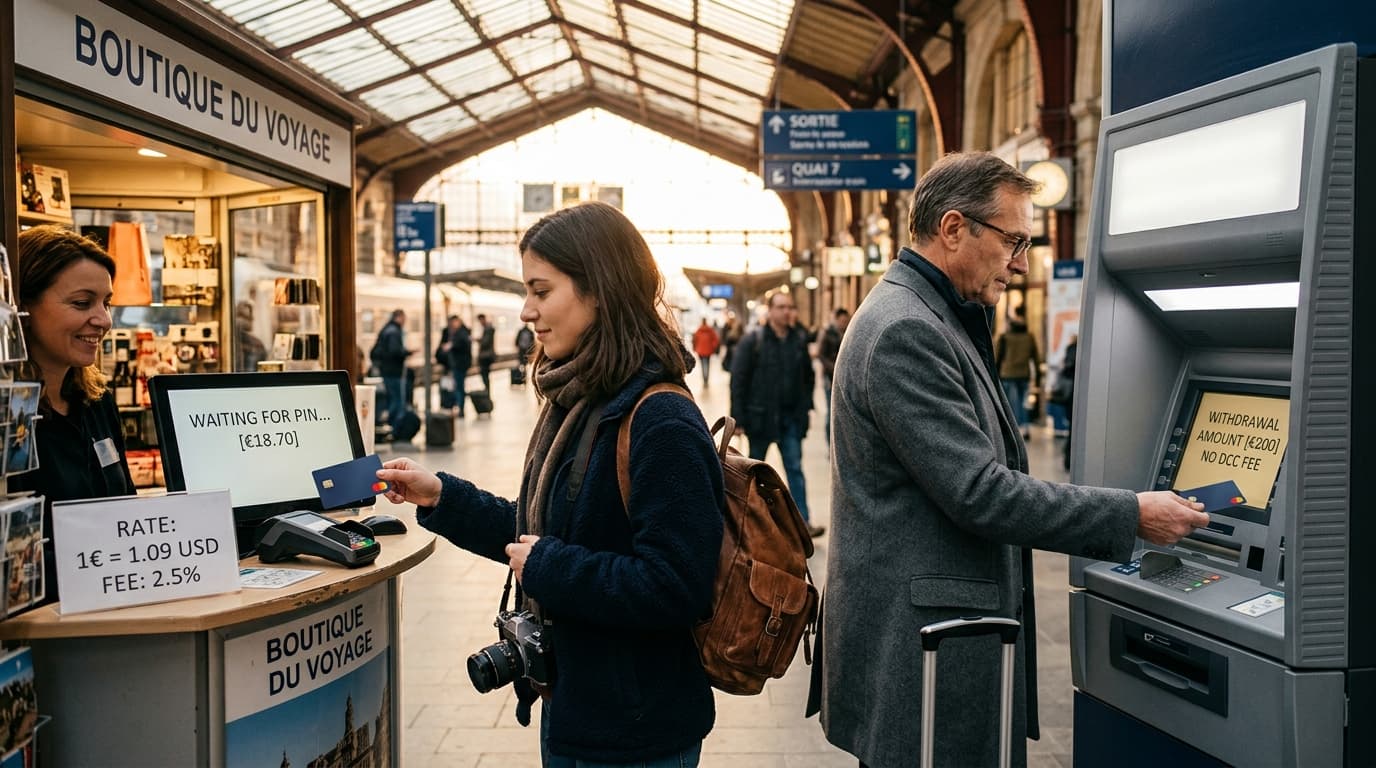
Belgians made 23.7 million trips in 2024, over three quarters of them abroad, according to Statbel. The moment the currency changes, fees pile up: exchange markup, ATM charges, dynamic currency conversion at the terminal. On a EUR 2,000 holiday budget, traditional Belgian banks quietly take EUR 30–40 in invisible fees. This guide breaks down every cost item, bank by bank, and explains how to bring them down to zero.
What fees apply when paying abroad with a Belgian card?
Three types of fees stack up on non-euro payments with a Belgian credit card.
Your bank's exchange markup. Every credit card transaction in a currency other than the euro goes through the Visa or Mastercard exchange rate, on top of which your bank adds its own margin. At ING and KBC, this markup is 1.6%. At Belfius, it is 1.5%. At Beobank, it reaches 2.1%. Keytrade Bank has the lowest markup among traditional Belgian banks at 1.4%. On a EUR 200 purchase in dollars with a credit card, that translates to EUR 3–4 in fees.
ATM withdrawal fees. Withdrawing cash abroad with a credit card costs significantly more than card payments. ING charges EUR 6 plus 1% of the amount. Beobank takes 2.5% with a EUR 5 minimum. Belfius has offered the first EUR 250 of non-euro ATM withdrawals free per month since July 2025, then charges EUR 5 plus 1%. These fees come on top of the exchange markup. A EUR 200 withdrawal outside the eurozone ends up costing EUR 10–12 at most Belgian banks. For the full fee breakdown by bank, see our dedicated guide.
Dynamic Currency Conversion (DCC). When a payment terminal or ATM abroad detects your Belgian credit card, it may offer to charge you in euros instead of the local currency. The applied rate includes a 3–7% margin over the interbank rate. This is the most expensive trap — and the easiest to dodge: always choose to pay in the local currency.
| Fee type | Typical amount | How to avoid |
|---|---|---|
| Bank exchange markup | 1.5–2% | Use Revolut or Wise |
| ATM withdrawal | EUR 5–15 + exchange | Pay by card, minimise withdrawals |
| DCC (dynamic conversion) | 3–7% | Choose the local currency on screen |
How much does paying abroad cost by Belgian bank?
Exchange markups vary threefold between traditional banks and neobanks. Here is the current comparison for a EUR 500 non-euro payment.
| Bank | Exchange markup | Cost on EUR 500 | ATM (EUR 200) |
|---|---|---|---|
| ING | 1.6% | EUR 8.00 | EUR 8 (6 + 1%) |
| KBC | 1.6% | EUR 8.00 | ~EUR 8 |
| Belfius | 1.5% | EUR 7.50 | EUR 0 (≤EUR 250/mo) |
| BNP Paribas Fortis | 1.6% | EUR 8.00 | ~EUR 8 |
| Beobank | 2.1% | EUR 10.50 | EUR 5 (min.) + 2.5% |
| Argenta | 2.0% | EUR 10.00 | ~EUR 10 |
| Keytrade Bank | 1.4% | EUR 7.00 | EUR 2.80 (2 + 0.4%) |
| Revolut Standard | 0% (≤EUR 1,000/mo) | EUR 0 | EUR 0 (≤EUR 200/mo) |
| Wise | ~0.4% | ~EUR 2.00 | EUR 0 (≤EUR 250/mo) |
| N26 Standard | 0% (Mastercard rate) | EUR 0 | 1.7% (outside EEA) |
| N26 Go/Metal | 0% | EUR 0 | EUR 0 (within limits) |
Verdict. For non-euro payments, Revolut Standard (free), N26 Standard (free, Mastercard rate with no markup) and Wise are unbeatable. Among traditional banks, Keytrade Bank offers the best rate at 1.4%. The big Belgian banks sit between 1.5 and 2.1% — Beobank is the most expensive, Belfius the cheapest of the lot.
How do Visa and Mastercard exchange rates work?
Visa and Mastercard each set their own exchange rate, updated daily. These rates are close to the interbank rate (the wholesale rate between banks), with a slight margin built in by the network itself.
Visa publishes its rate via an official calculator. The Visa rate includes a margin of about 0.2–0.5% over the interbank rate, depending on the currency pair. This rate is the same for all issuing banks — it is your bank's added markup that makes the difference.
Mastercard publishes its settlement rate on its own platform. The methodology is similar: a built-in margin of 0.2–0.5% over the interbank rate. Gaps between Visa and Mastercard rarely exceed 0.2% on major currencies (USD, GBP, CHF, SEK).
In practice, the choice between Visa and Mastercard has almost no impact on the final cost. Your bank's markup (1.5–2%) is 5–10 times larger than the difference between the two networks. For exotic currencies (Thai baht, South African rand, Mexican peso), the gaps can be slightly wider — check both calculators the day before departure if the amount is significant. Our Visa vs Mastercard comparison goes deeper into the differences.
Why is DCC the most expensive trap abroad?
DCC (Dynamic Currency Conversion) is a conversion service offered by the merchant or ATM operator — not by your bank. When the screen asks "Pay in EUR?", the applied rate comes from the DCC provider (often Fexco, Global Blue or Planet), which includes a 3–7% margin over the interbank rate.
A worked example: you buy an item for GBP 100 in the United Kingdom. The interbank rate gives EUR 116.50. With DCC, the terminal shows EUR 121–123 — a EUR 4.50–6.50 surcharge. Without DCC using your Belgian card, you pay EUR 116.50 plus your bank's markup (1.5–2%), coming to EUR 118.25–118.83. The difference reaches EUR 3–4 on a single transaction.
DCC is particularly common in four situations:
- ATMs in tourist areas (airports, train stations, city centres). Euronet machines are known for defaulting to DCC.
- Payment terminals in tourist-facing hotels and restaurants.
- Foreign e-commerce sites that detect your Belgian card (Amazon.com, Booking.com in certain currencies).
- Automated petrol stations abroad.
The rule is simple: always decline DCC. On screen, select "local currency" or "charge in [country's currency]". If the terminal gives you no choice, ask the merchant to re-run the transaction in the local currency.
ATM cash withdrawals abroad: when and how to limit fees?
Foreign ATM withdrawals stack two layers of fees: your bank's fixed withdrawal charge and the exchange markup. A EUR 200 withdrawal in a foreign currency costs EUR 8–12 at most Belgian banks. By comparison, a card payment of the same amount costs only EUR 3–4 (exchange markup alone).
Three rules to limit the damage:
Pay by card whenever possible. Wherever a terminal accepts Visa or Mastercard, use your card. It is systematically cheaper than an ATM withdrawal. Even in countries where cash is still common, major cities increasingly accept card payments.
If you must withdraw, take out a large amount in one go. Fixed fees (EUR 5–6) weigh more heavily on small withdrawals. A EUR 400 withdrawal with EUR 6 in fixed fees represents 1.5%. Four withdrawals of EUR 100 cost EUR 24 in fixed fees — 6%.
Avoid private ATMs. Euronet, Travelex and other private operators in tourist zones charge their own fees on top of your bank's, and systematically push DCC. Look for an ATM belonging to a local bank.
For frequent travellers, Revolut and Wise offer free ATM withdrawals up to EUR 200 per month (EUR 250 at Wise since May 2026). Beyond that, Revolut charges 2% and Wise applies 2.69%. N26 Standard charges 1.7% outside the EEA, while N26 Go and Metal offer free withdrawals within certain limits. Details in our fee-free travel guide.
What is the best strategy for paying less abroad?
The optimal strategy combines two cards: a traditional Belgian card and a neobank. This is not theoretical advice — it is the most cost-effective setup for a Belgian traveller.
Primary card for everyday payments: Revolut Standard or Wise. Revolut applies the real interbank rate with no markup on foreign currency payments, up to EUR 1,000 per month (beyond that, a 1% surcharge applies). A 1% surcharge also applies on weekend conversions with the Standard plan. Wise applies the interbank rate with transparent fees of 0.33–0.55% depending on the currency. For a two-week trip with EUR 2,000 in spending, the savings compared to an ING or Belfius card reach EUR 25–35.
Backup card: your traditional Visa or Mastercard. It serves as a safety net for three reasons. Payment limits are higher (often EUR 2,500–5,000 per month). Travel insurance included in Gold cards covers cancellation, medical repatriation and lost luggage. And if something goes wrong with the neobank (frozen account, technical outage), you still have access to funds.
Three things to check before departure:
- Verify your payment and withdrawal limits in the app — increase them temporarily if needed.
- Enable push notifications for every transaction — a suspicious charge shows up immediately.
- Write down your banks' emergency numbers (not just Card Stop at +32 78 170 170) — the number on the back of your physical card is the most direct line.
What to do if your card is lost or stolen abroad?
The first reflex is to block the card through the banking app — all Belgian banking apps (ING, KBC, Belfius, BNP, Beobank) allow instant blocking from abroad. If the app is not working, call Card Stop at +32 78 170 170, available 24/7 from abroad.
Network emergency services:
Visa offers the Visa Global Customer Assistance Service. This service can issue an emergency replacement card (within 24–72 hours depending on the country) and provide an emergency cash advance at partner bank branches. The number varies by country — check the Visa website before departure.
Mastercard offers Mastercard Emergency Services, with the same capabilities: temporary replacement card and emergency cash advance. The global emergency number is accessible through the Mastercard website.
While waiting for a replacement, if you followed the two-card strategy, your second card takes over. Apple Pay and Google Pay continue to work even if your physical card is blocked, provided your bank does not also block the digital token — check this in the app. For details on fraud and Card Stop procedures, see our dedicated guide.
Does the CBPR2 regulation protect payments abroad?
The EU Cross-Border Payments Regulation (924/2009, amended by Regulation 2021/1230, known as CBPR2) imposes a clear rule: a cross-border euro payment within the EEA must cost the same as a domestic euro payment. In practice, if your ING card charges nothing for a euro payment in Belgium, it cannot charge anything for a euro payment in Spain or Germany either.
This regulation does not cover payments in currencies other than the euro. A payment in British pounds, US dollars or Swedish kronor remains subject to your bank's exchange markup. CBPR2 did, however, add a transparency requirement: since April 2020, your bank must display the total cost of foreign currency conversion expressed as a percentage margin against the ECB reference rate, before you validate the transaction. This transparency lets you compare banks — but it does not cap the fee amount.
For travellers within the eurozone (France, Spain, Italy, Portugal, Greece, the Netherlands, Germany, Austria), the good news is that your Belgian credit card works with zero extra charges for euro payments and withdrawals. Fees only appear outside this zone.
FAQ
Answers to frequently asked questions about paying abroad with a Belgian credit card are detailed in the FAQ section above.
Comparator Guides & Advice
Compare side by side.
Compare now →
Frequently asked questions
Keep reading
Sophie L. worked eight years in a Belgian bank branch, first as a credit adviser and then in customer relations, before going independent in 2021 and settling in Louvain-la-Neuve. Her work starts with the issuers' official fee schedules, from the high-street banks (ING, BNP Paribas Fortis, KBC, Belfius) to the neobanks (Revolut, N26, Wise), reduced to five comparable lines: annual fee, currency conversion charge, borrowing rate, spending limits and bundled insurance. Every price on this site carries the date it was checked: the annual-fee grid was gone through line by line on 12 August 2026, after Belfius moved its Beats Star package to 5.90 € a month in February. If an issuer does not publish a figure, she writes that down instead of estimating it. For readers who moved to Belgium, she spells out what a Belgian issuer expects from an applicant with no local credit history.