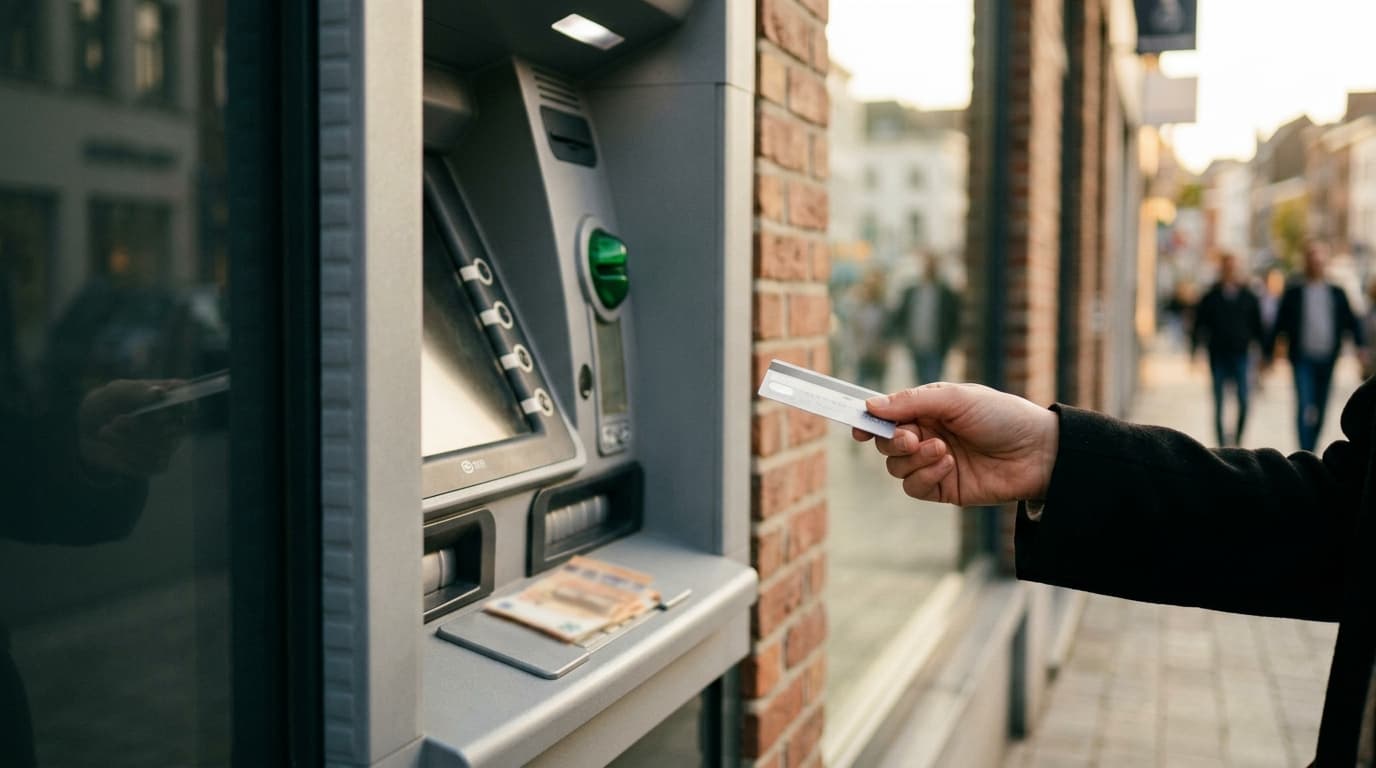
Withdrawing cash with your credit card at an ATM looks harmless. Same PIN entry, same machine, same banknotes coming out. Except the bill is steep. Fixed fees, a percentage of the amount, currency margins abroad, and — crucially — interest that starts accruing the second the banknotes leave the machine. Not at the end of the month. Immediately.
How much does an ATM withdrawal cost, bank by bank?
Belgian banks charge a fixed amount per withdrawal, often combined with a percentage of the amount withdrawn. Outside the eurozone, a currency margin is added to the total. Here are the rates in effect as of May 2026.
| Bank | ATM withdrawal fee | Currency margin (non-euro) |
|---|---|---|
| Keytrade Bank | 0 EUR (eurozone) / 2 EUR + 0.4% (non-euro) | 1.4% |
| Belfius | 5 EUR + 1% | 1.5% |
| KBC | 1% (min. 5 EUR) | 1.6% |
| BNP Paribas Fortis | 6 EUR + 1% | 1.6% |
| ING | 6 EUR + 1% | 2% |
| Argenta | 6 EUR flat | 2% |
| Beobank | 2.5% (min. 5 EUR, max. 15 EUR) | 2.1% |
Take a 200 EUR withdrawal at an ATM in the eurozone. At Keytrade, the withdrawal is free. At ING, the same withdrawal costs 8 EUR (6 EUR + 2 EUR). If that withdrawal takes place in Thailand, Keytrade charges 5.60 EUR (2 EUR + 0.80 EUR fee + 2.80 EUR currency margin) versus 12 EUR at ING (8 EUR + 4 EUR currency margin). Keytrade is the only traditional bank offering free eurozone ATM withdrawals.
Why does interest start immediately?
When you pay for a purchase with your credit card, the bank grants you a grace period. You pay no interest if you repay the full balance at the end of the month. This mechanism does not apply to cash withdrawals.
An ATM withdrawal is legally a cash advance, not a purchase. The bank considers it a cash loan, and interest accrues from the day of the transaction. The APR applied is that of your credit facility: between 9.35% (KBC Flex Budget) and 14.49% (Beobank). It's the same rate as for instalment repayment of purchases, except here it kicks in automatically.
In numbers: a 500 EUR withdrawal repaid 25 days later costs roughly 5 EUR in additional interest at 14.49% APR, on top of the withdrawal fees. The amount seems modest, but it adds up with each withdrawal and over the entire period before repayment.
What are the withdrawal limits on a credit card?
The cash withdrawal limit is separate from your overall credit limit. Most Belgian banks cap ATM withdrawals at a fraction of your total credit ceiling.
| Parameter | Typical range |
|---|---|
| Daily limit | 300 – 1,000 EUR |
| Weekly limit | 1,500 – 2,500 EUR |
| Share of credit limit | 25 – 50% of total ceiling |
At Belfius, you can adjust these limits through the mobile app. KBC and ING offer temporary increases for travel. BNP Paribas Fortis sets a default limit of 620 EUR per 4-day period, extendable at a branch or through Easy Banking.
These limits exist to cap fraud risk and prevent excessive use. If you need large amounts of cash, the bank would rather direct you toward a wire transfer or personal loan — both cheaper options than a credit card cash advance.
Withdrawals abroad: what extra fees apply?
Outside the eurozone, two layers of fees stack on top of regular withdrawal charges: your bank's currency margin and, potentially, the ATM's dynamic currency conversion (DCC).
The currency margin is automatic. Your bank applies a percentage on the ECB reference rate for every transaction in a foreign currency. This percentage ranges from 1.4% (Keytrade) to 2.1% (Beobank) and is added to the withdrawal fees. Since the CBPR2 regulation came into effect, banks must clearly disclose this cost. In practice, the information appears in the terms and conditions, rarely at the moment of withdrawal.
DCC is avoidable. The ATM offers to convert the amount into euros before the withdrawal, at a rate it sets itself. This rate is on average 3 to 7% more expensive than the interbank rate. Simply select the local currency on screen to avoid it.
All in: a 300 EUR withdrawal in British pounds with an ING card and DCC accepted can exceed 25 EUR in combined fees (9 EUR bank charges + 15 to 21 EUR DCC surcharge). By refusing DCC and using Keytrade, the same withdrawal comes to around 7.40 EUR.
Are neobanks a better option for ATM withdrawals?
For ATM withdrawals, neobanks offer significantly better terms than traditional Belgian banks. But these are debit cards, not credit cards — buyer protection and chargeback rights are more limited.
| Neobank | Free withdrawals | Beyond the limit | Currency margin |
|---|---|---|---|
| Revolut Standard | 200 EUR or 5 withdrawals/month | 2% (min. 1 EUR) | 0% (up to 1,000 EUR/month) |
| N26 Standard | 2 withdrawals/month | 2 EUR/withdrawal | 0% on payments (1.7% ATM non-euro) |
| Wise | 250 EUR/month | 2.69% | Real rate + 0.33–0.55% |
For a traveller withdrawing 200 EUR per month abroad, Revolut costs 0 EUR in withdrawal fees versus 12 EUR at ING. The savings over a two-week trip with three withdrawals can reach 30 EUR.
When does a credit card cash withdrawal make sense?
In three specific situations, withdrawing cash with a credit card may be the only reasonable option.
Emergency abroad. Your debit card is blocked, lost or swallowed by the ATM. The credit card serves as backup. In this case, withdraw enough in one go to cover your needs — fixed fees weigh less on a large withdrawal than on several small ones.
Cash-only destination. Some countries or regions do not accept cards for small expenses. If you don't have a suitable debit card (Revolut, Wise), the credit card lets you obtain local currency. Arrange currency exchange before departure when possible.
One-off cash flow gap. Your current account is temporarily empty and you urgently need cash. A credit card withdrawal is less expensive than an unauthorised overdraft (which can reach 11% APR plus fixed fees). Repay as quickly as possible to limit interest.
In all other cases, a debit card or bank transfer is preferable. A personal loan is also cheaper than a series of credit card withdrawals if you need cash over several weeks.
How to reduce the bill when you must withdraw?
Five habits to limit the damage when a credit card cash withdrawal is unavoidable.
Withdraw a large sum at once. Fixed fees (2 to 6 EUR) apply to each transaction. A single 400 EUR withdrawal costs 10 EUR at ING (6 EUR + 1%). Four withdrawals of 100 EUR cost 28 EUR (4 × 7 EUR) — 18 EUR more for the same amount.
Repay immediately. Through your banking app, make a transfer to your credit card account on the same day as the withdrawal. Since interest is calculated daily, a prompt repayment reduces the charge to a few cents.
Refuse DCC. At foreign ATMs, always choose the local currency. DCC adds 3 to 7% to the real rate, which can turn a 200 EUR withdrawal into 214 EUR before bank fees even apply.
Check the local ATM's own fees. Some independent ATMs charge their own access fees on top of your bank's charges. Standard bank ATMs in Belgium and the eurozone generally do not charge additional fees.
Compare with your debit card. In Belgium, Bancontact withdrawals are free at your bank's ATMs and at Batopin CASH points. Even abroad, a debit card is almost always cheaper than a credit card at the ATM.
FAQ
Answers to the most common questions are in the FAQ section above. For a full overview of all fees associated with your card, see our guide to hidden credit card fees in Belgium. If you're looking for a travel-friendly card, our comparison of travel credit cards with no fees details the best options to minimise costs abroad.
Comparator Guides & Advice
Compare side by side.
Compare now →
Frequently asked questions
Keep reading
Sophie L. worked eight years in a Belgian bank branch, first as a credit adviser and then in customer relations, before going independent in 2021 and settling in Louvain-la-Neuve. Her work starts with the issuers' official fee schedules, from the high-street banks (ING, BNP Paribas Fortis, KBC, Belfius) to the neobanks (Revolut, N26, Wise), reduced to five comparable lines: annual fee, currency conversion charge, borrowing rate, spending limits and bundled insurance. Every price on this site carries the date it was checked: the annual-fee grid was gone through line by line on 12 August 2026, after Belfius moved its Beats Star package to 5.90 € a month in February. If an issuer does not publish a figure, she writes that down instead of estimating it. For readers who moved to Belgium, she spells out what a Belgian issuer expects from an applicant with no local credit history.