This article is being re-checked against official sources. The fees it quotes may be out of date: the reference figures are those of the comparator, read on the issuers’ pages on 19 November 2026.
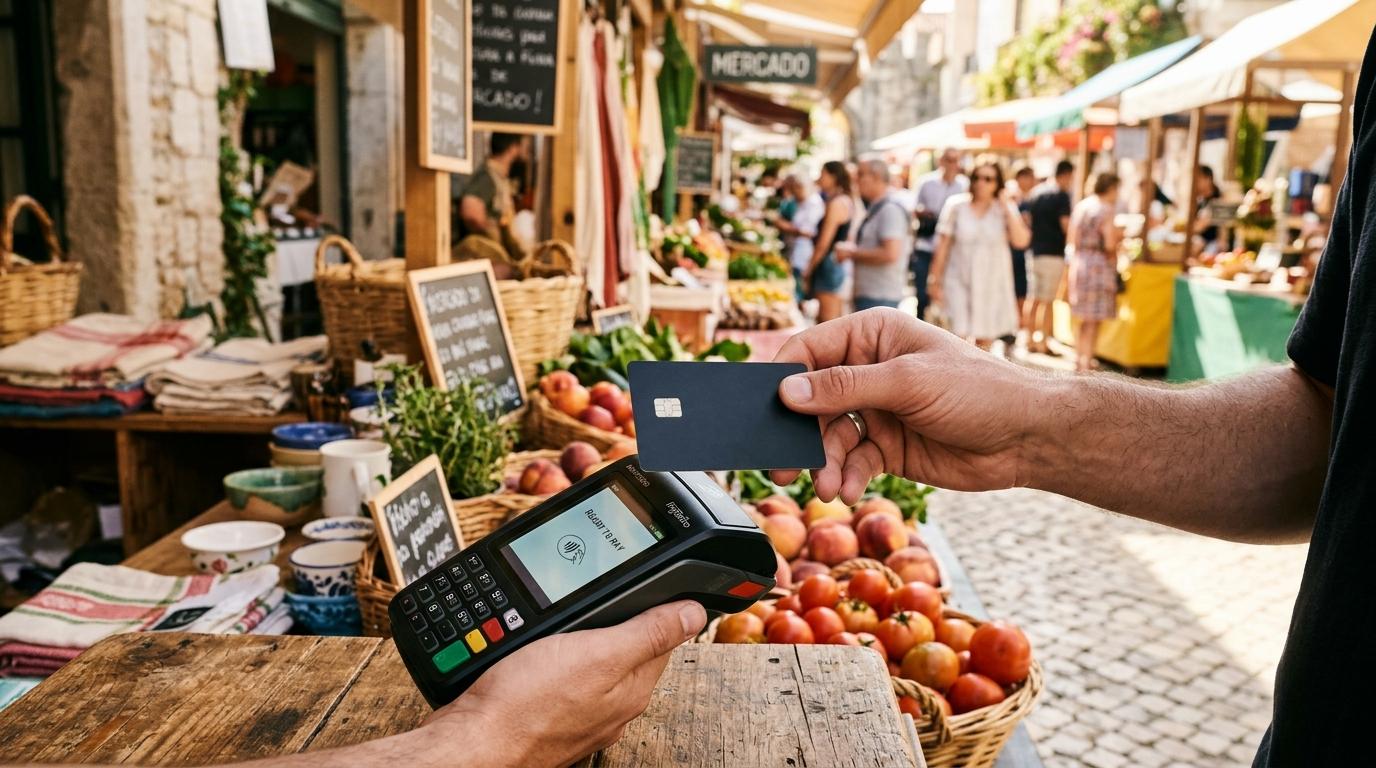
Outside the euro area, pay in the currency of the country. When the terminal offers to charge you in euros, it is the merchant or its provider doing the conversion, with its own mark-up, and your bank never sees it. On 100 dollars, at the European Central Bank (ECB) rate of 9 November 2026, the gap runs from a few cents to more than 3 euros. At a cash machine, it is counted in tens of euros.
This conversion is called dynamic currency conversion, or DCC. Our fees glossary defines it, and our guide to paying abroad covers general card use outside Belgium. The other cost items, annual fee and withdrawal charges included, are listed on our page about hidden credit card fees. Here, the two options are set side by side with figures, and refusing on the screen is described step by step.
100 dollars in New York: 90.68 euros in dollars, up to 93.81 in euros
On 9 November 2026, the European Central Bank set the euro at 1.1193 dollars. A 100 dollar purchase is therefore worth 89.34 euros at the reference rate. Everything above that is margin.
If you choose dollars, your bank converts. According to its page on travelling outside Europe (French), read on 10 November 2026, Belfius applies a 1.50% exchange margin to credit card payments, with no other charges. If you choose euros, the margin is the merchant's, and no recent Belgian source measures it. The only figures I found are old: in its position paper of 30 October 2017, the European consumer organisation BEUC cites a Stiftung Warentest survey in thirteen non-euro countries, with an extra cost of 2 to 5% in shops and 2.6 to 12% at cash machines.
| Option chosen on screen | Who converts | Margin used | Cost of 100 dollars |
|---|---|---|---|
| Dollars, Belfius card | Your bank | 1.50% | €90.68 |
| Euros, low merchant margin | The merchant or its provider | 2% | €91.13 |
| Euros, high margin in a shop | The merchant or its provider | 5% | €93.81 |
| Euros, worst case found at a cash machine | The machine operator | 12% | €100.06 |
My calculation, at the ECB rate of 9 November 2026. Belfius applies its margin to its own reference rate, which may differ slightly from the ECB's.
A common belief falls here. With a 2% commercial margin, paying in euros costs only 45 cents more than with Belfius. At 5%, the gap rises to 3.13 euros, and it adds up on every payment of a two-week stay in the United States. The problem is not that euros are always ruinous. It is that you do not know the margin at the moment you choose, unless you read it and compare it in your head in three seconds in front of a queue. Exchange is also only one item in a card's yearly bill, broken down in the pillar on what a credit card costs.
Why does the merchant offer you euros?
Because it earns from it. Worldline, an acquirer based in Brussels, presents dynamic conversion to Benelux merchants as a source of "additional revenue", on a page dated 7 July 2026 (French) that advertises more than 40 currencies and remote activation of the terminal. The same page publishes neither the margin charged to the customer nor the share passed on to the merchant.
The argument put to the customer is transparency: you see the exact amount in your currency before paying, with no surprise on the statement. That is true, and it is the option's only concrete advantage.
You are paying for certainty.
An American tourist paying in Bruges on a Worldline terminal is offered dollars, as you are offered euros in Phuket. Worldline promises them a best-rate guarantee, refunding the difference if they find a better rate from their bank on the same day. I have not read its conditions, and nothing suggests a foreign provider offers the same to Belgians travelling.
European law requires the margin to be shown, without capping it
Since 19 April 2020, the rule has come from Regulation (EU) 2019/518, now carried into Article 4 of Regulation (EU) 2021/1230 on cross-border payments. The party offering conversion at the terminal or cash machine must express its total charges "as a percentage mark-up" over the latest ECB reference rates, and tell you before the payment. It must also show the amount in the merchant's currency and in your account's currency, and inform you that you can pay in the local currency.
Nothing in this text limits the margin. A compliant screen can show a 9.9% mark-up, the one on a cash machine screen reproduced by BEUC in its 2017 paper.
Your bank must express its own margin the same way. KBC thus publishes, on its page on payments abroad (French), its 1.6% commission "compared with the ECB reference exchange rate" for European Economic Area (EEA) currencies. For the dollar or the baht, this page, read on 10 November 2026, gives no percentage, so I cannot price the same purchase with KBC.
This framework applies in the European Union. It covers a Polish or Swedish merchant's terminal; in the United States, Thailand or Turkey the regulation does not apply, and only the card networks' rules, which I have not read, govern what the screen must show.
At the cash machine, the gap runs into tens of euros
Take a 200 dollar withdrawal, or 178.68 euros at the ECB rate; the usual costs of a cash withdrawal with a credit card have their own guide. In local currency with a Belfius Mastercard New, Star or Platinum, the withdrawal is free up to 250 euros a month and only the 1.50% margin applies: 181.36 euros. Accepting euros on the screen triggers two costs at once. The machine operator takes its conversion margin, and Belfius charges a withdrawal outside the euro area booked in euros 5 euros plus 1% of the amount, from the first euro, according to the same page re-read on 10 November 2026.
With the low margin found by Stiftung Warentest (2.6%), the withdrawal accepted in euros comes to 190.16 euros, 8.80 euros more. With the high margin (12%), it reaches 207.13 euros, and the gap climbs to 25.76 euros for a single withdrawal, using the same calculation. The machine operator's own fees, which the owner of the machine must display at the time of withdrawal, come on top in both cases.
At Belfius, accepting euros at a foreign cash machine therefore means paying twice, first the operator, then the bank.
How to refuse conversion at the terminal or cash machine?
The refusal happens on a single screen, before the PIN. Wikifin, the financial education site of the Belgian regulator FSMA, sums it up on its page about paying abroad (French), updated on 2 November 2026: for a card payment or a cash withdrawal in foreign currency, choose the local currency.
- When the terminal shows two amounts, choose the one in the country's currency (USD, CHF, GBP, THB), and leave aside the one in EUR.
- If the merchant holds the terminal and chooses for you, ask for local currency before it is handed to you; the merchant can cancel and restart the transaction as long as it has not been approved.
- At a cash machine, look for an option such as "without conversion" or "decline conversion"; a screen promising a "guaranteed rate" usually pushes towards conversion.
- Only type your PIN after checking the currency shown.
- Keep the receipt until you have read the statement.
Signs that a conversion was applied anyway:
- the receipt shows an amount in euros for a purchase made in another currency;
- an exchange rate or a percentage mark-up appears on the receipt;
- the transaction reaches your statement directly in euros, without the original currency or your bank's rate;
- the terminal asked you to confirm "your currency".
I refuse conversion every time, even when the likely gap is a few cents. Comparing two amounts and a mark-up in three seconds, at the counter of a Zurich café, is not something I do well, and I know nobody who does it well.
In the euro area, the choice does not exist
In Lisbon, Vienna or Athens, you pay in euros and the question does not arise. It does arise in EU countries that keep their own currency, such as Poland, Czechia, Hungary or Sweden, where Stiftung Warentest found the highest margins. Our page on the Belgian credit card abroad shows in which countries your issuer treats the card as used in Europe.
What to do if the conversion has already been accepted?
First, go back to the counter if you are still there. A transaction can be cancelled by the merchant and redone in local currency, which settles everything; once you have left, it is much harder.
After the fact, the transaction is authorised: you approved the amount shown, and the refund logic for unauthorised transactions does not apply. My reading, which no bank or ombudsman has confirmed, is that a complaint only has traction if the screen did not show you the mark-up where Article 4 of Regulation 2021/1230 required it, that is, for a terminal located in the Union. In that case, write to your issuer with the receipt and the date, and ask whether it can dispute the transaction with the card network. No Belgian issuer page I re-read describes this case. Outside the Union, I treat the purchase as lost and would not spend an evening on it. Full preparation for a trip, from limits to deposits, is in the guide to travelling with a Belgian card.
Pages re-read on 10 November 2026: Belfius (travelling outside Europe), KBC (paying and withdrawing abroad), Wikifin (updated 2 November 2026), ECB rate of 9 November 2026, Regulation (EU) 2021/1230 on EUR-Lex; BEUC paper of 30 October 2017 and Worldline page of 7 July 2026.
Comparator Guides & Advice
Compare side by side.
Compare now →
Frequently asked questions
Keep reading
The meilleure-carte-credit.be editorial team reproduces the fees issuers publish themselves: product pages, fee lists and fee information documents from Belgian banks (ING, BNP Paribas Fortis, KBC, Belfius, Beobank, Argenta, Keytrade Bank) and neobanks (Revolut, N26, bunq, Wise). Every figure links to its official source and carries the date we read it. When an issuer does not publish a figure, we say so instead of estimating it. Last full reading of the comparator: 19 November 2026.