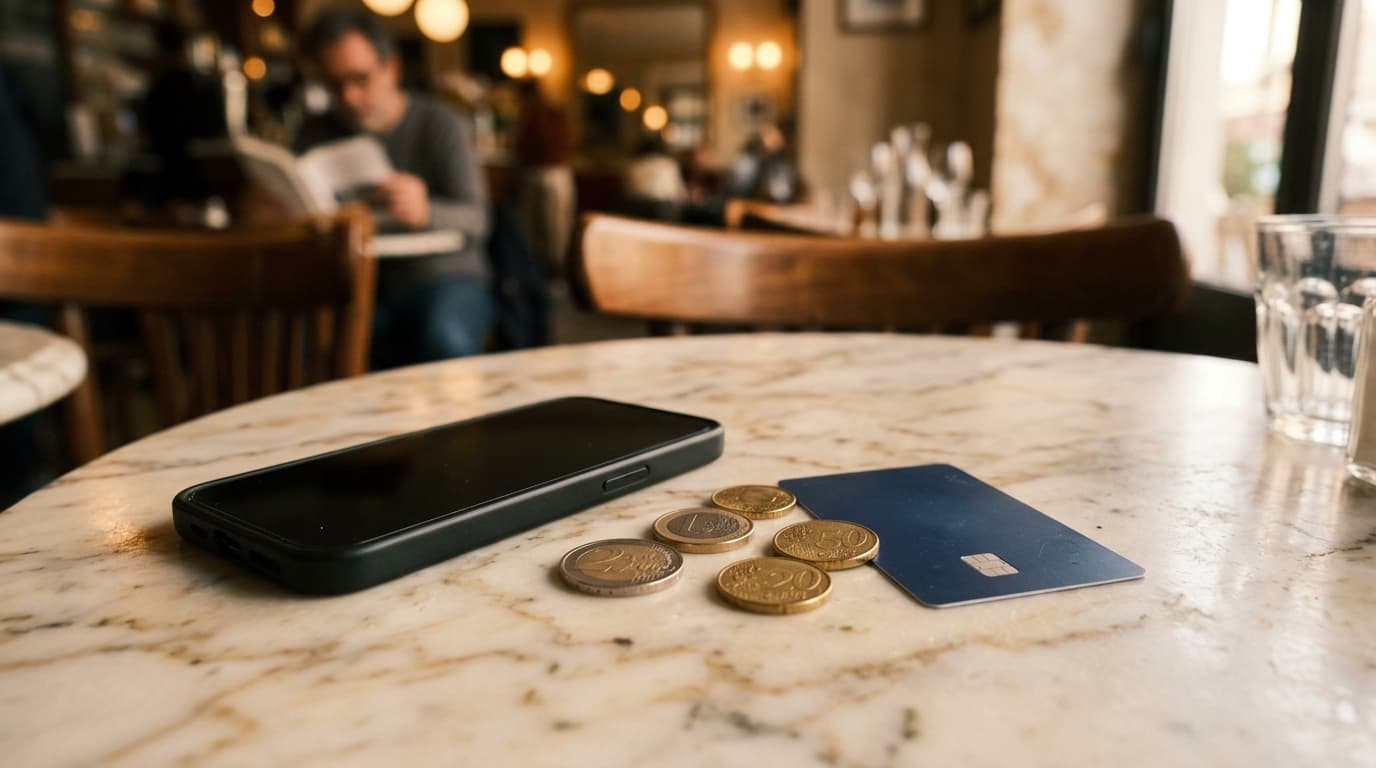
Yes, you can pay without a credit card in Belgium, and most households already do without thinking about it. The debit card, the mobile wallet, the prepaid card and the foreign currency account cover almost everything. Deposits, deferred payment and some purchase protections hold out against them. No alternative closes all three at once.
Contents:
- Living without a credit card in Belgium, and its three blind spots
- Paying later without a card: split payments and personal loans
- The prepaid card, for tight budgets and refused applications
- Mobile wallets, Wero and Bancontact Pay
- Visa Debit and the deposit
- Outside the euro area: the foreign currency account against the credit card
Can you live without a credit card in Belgium?
For everyday life, easily. Bancontact claimed nearly 18 million cards in circulation and more than 2.5 billion transactions a year in its announcement of 6 November 2025. Supermarket, pharmacy, bakery, car park, motorway toll: the debit card works almost everywhere, and it now works abroad too.
The change dates from the retirement of Maestro. Belgian banks have gradually swapped that network for Visa Debit or Debit Mastercard, a switch that Wikifin, the FSMA's financial education portal, describes on its page about debit and credit cards inside and outside the euro area, updated on 17 February 2025. A recent Bancontact card therefore carries two networks on the same piece of plastic, and that double logo covers a good share of the uses once reserved for credit cards. Our comparison of Bancontact and the credit card sets out the cases where one is enough.
The underlying difference has nothing to do with the logo. A debit card takes the amount from the account at the moment of payment; a credit card backed by a credit facility groups spending and debits it later, from a reserve that is not your money. The full mechanism, issuer, statement and direct debit, is laid out in our guide to how credit cards work, and the line between the two products in our article credit card or debit card.
A hotel or rental deposit, interest-free spreading over three to five weeks and the insurance tied to paying by card remain out of reach for anyone who goes without. Each alternative closes one of those gaps, never all three.
Paying later without a credit card means signing up for another credit
Deferred payment is the easiest use to replace, and the most misleading.
Online split payment, led by Klarna, offers three interest-free instalments at checkout, and KBC offers the same formula at Carrefour from a 75-euro purchase. The customer pays nothing extra as long as the dates are met. That simplicity has an expiry date: Directive (EU) 2023/2225, known as CCD2, brings split payment under the consumer credit regime from 20 November 2026, with a creditworthiness check, pre-contractual information and a right of withdrawal. Since 1 December 2025, Belgian law has already banned granting it to minors. The instalment rates charged by banks and the formulas of providers active in Belgium are compared in our guide to instalment payments and BNPL, and the sums for a purchase spread over ten months in paying in several instalments.
The personal loan is the other door, and intuition gets it wrong. For the same 750 euros, the pre-contractual information sheet of the Beobank Young Mastercard, read on 17 September 2026, shows 20.50 % APR for an instalment loan or instalment sale against 16.49 % for the credit facility attached to the card. On small amounts, the "classic" loan is not necessarily the cheaper option. Both regimes and their players are defined in our glossary of law and players.
On this point I do not compromise. Dropping a credit card to replace it with three split-payment providers does not reduce debt, it fragments it, and fragmentation is the hardest form of debt to follow: three schedules, three dates, three possible reminders. A single card paid off in full every month remains the most readable tool of all.
The prepaid card, last resort and first budgeting tool
A prepaid card spends only the balance loaded onto it. It opens no credit, which is why it escapes a check at the National Bank's Central Individual Credit Register: it is often the only card within reach after a refusal or a listing at the credit register.
The Belgian market changed this year. bpaid closed at the end of February 2026, and Nickel, sold through post offices, took over its customers at 25 euros a year. Network banks keep cheaper formulas, 12 euros a year at KBC and 15 at Belfius according to our prepaid card ranking, checked on 28 August 2026. Our prepaid card guide details the minimum ages and top-up ceilings.
For a teenager, it is above all a budgeting tool: the balance sets the limit, and no overdraft can open up behind it.
Its weakness is the debit card's, only harsher. A car rental company or a hotel rarely accepts it as a guarantee.
Do Apple Pay, Wero or Bancontact Pay replace a credit card?
Apple Pay, Google Pay and Samsung Wallet replace nothing: they dematerialise an existing card. A debit card added to the phone stays a debit card, with its deposit and fee rules, and a credit card added keeps its insurance. Compatible banks, tokenisation and limits are covered in our Apple Pay, Google Pay and Samsung Wallet guides, and physical contactless in our article on contactless payment.
Wero plays in another league. It is an instant account-to-account transfer, triggered from the banking app with a phone number or QR code, with no card network involved. Bancontact announced on 6 November 2025 that the Payconiq brand would disappear in 2026, that the app would become Bancontact Pay for its two million users, and that merchant stickers would show, from spring 2026, a QR code shared by Bancontact Pay and Wero. Compatible banks and the 120-day protection on online purchases are in our Wero guide.
Wero leaves me in two minds. To pay back a friend or settle with a tradesman, it removes a pointless step and I see no flaw in it. For an online purchase from an unknown merchant, I keep a card: an instant transfer leaves in ten seconds, and the dispute route rests on a young procedure for which nobody, so far, has published refund statistics.
Visa Debit accepts the deposit, but blocks it on your own money
Hello bank! says it plainly on its page about the Bancontact Visa Debit, dated 15 March 2024 and read on 28 September 2026: a rental or accommodation deposit can be placed with the debit card, but the reservation sits on the payment account, and the sum, which "can be high", becomes unusable until it is released. The bank itself advises keeping a credit card for that case.
The same page holds the most useful fact for anyone without a credit card: on a merchant site that only shows a "credit card" option, you can pick it and enter the Visa Debit number and CVV code, the amount then being debited immediately. It also recalls that a debit card is obtained without approval based on income, unlike a credit card.
One example is enough to measure what is at stake: a 1,500-euro deposit blocked on an account holding 2,000 leaves 500 euros available for the rest of the stay, and for any direct debits that fall due in the meantime.
Acceptance, for its part, is out of the bank's hands. The rental company alone decides whether it takes a debit card as a guarantee, and several refuse any card that is not a credit card in the driver's name, as our guide to the credit card needed to rent a car shows.
Outside the euro area, a foreign currency account costs less than the credit card
On this ground, the investigation surprised me. The most expensive alternative abroad is the one everyone carries, and the cheapest is a free option. Almost nobody switches it on.
Wikifin publishes a reading guide to the fees Belgian banks charge outside the euro area. With a debit card, a payment at a merchant bears both a 1.6 % transaction fee and a 1.5 to 2 % exchange commission. With a credit card, only the exchange commission applies. The portal specifies that these figures are indicative, and it is the gap between the two that matters: paying in dollars with a standard bank's debit card costs roughly twice as much as with the same bank's credit card.
The foreign currency account reverses that ranking. At KBC, it is a free sub-account of the current account, opened in a few taps in the app, which holds 29 currencies, from the US dollar to the Thai baht. According to the foreign currency account page read on 28 September 2026, exchange is free up to 1,500 euros a month, then charged at 1 % above that; paying by debit card in a currency you hold is free and unlimited; so is withdrawing from a cash machine, apart from any fees charged by the foreign operator. One practical condition: a recent debit card, recognisable by the notch on its edge, failing which KBC sends a new one within 5 to 12 working days.
Fees on 1,000 then 2,000 euros spent in dollars within the month, on weekdays, according to the dated sources below:
| Payment method | 1,000 EUR spent | 2,000 EUR spent | Source and date |
|---|---|---|---|
| Standard Belgian debit card | 31 to 36 EUR (1.6 % + 1.5 to 2 %) | 62 to 72 EUR | Wikifin, 17/02/2025 |
| Belgian credit card | 15 to 20 EUR (1.5 to 2 %) | 30 to 40 EUR | Wikifin, 17/02/2025 |
| KBC debit card and foreign currency account | 0 EUR commission | 5 EUR (1 % on 500 EUR) | KBC, 28/09/2026 |
| Revolut Standard | 0 EUR | 10 EUR (1 % above 1,000 EUR) | Revolut Belgium terms, read on 06/09/2026 |
One profile clearly comes out ahead: for a traveller banking with KBC or CBC who spends less than 1,500 euros a month outside the euro area, the foreign currency account is the best alternative to a credit card on the Belgian market, well ahead of so-called "no foreign fee" cards. Two reservations still stop me from making it a general recommendation. KBC does not state on that page the rate applied at the moment of exchange, and a zero commission says nothing about any gap with the reference rate; I found that figure nowhere. And the bank itself answers, in the FAQ on the same page, that it remains useful to keep a credit card in reserve abroad, because some merchants accept nothing else and deposits get blocked on it.
Before cancelling a credit card in favour of an alternative, these checkpoints avoid unpleasant surprises:
- the deposit policy of your usual car rental company, read in its terms rather than on a comparison site;
- where you travel, inside the euro area or not, and how much you spend there each month;
- the delivery date of a new compatible debit card, if your bank requires a replacement before enabling currencies;
- the travel or purchase insurance you lose with the card, rarely replaced by another formula at the same price;
- the real annual cost of the card you keep or drop, exchange fees included.
The summary by situation, as the sources read on 28 September 2026 draw it:
| Situation | Alternative that holds | Where it breaks |
|---|---|---|
| Groceries, restaurant, pharmacy in Belgium | Bancontact Visa Debit card | Nowhere |
| Purchase on a foreign website | Visa Debit entered as a credit card | No deferred payment |
| Paying back a friend, paying a tradesman | Wero, Bancontact Pay | Limited protection on a transfer |
| Spreading a purchase over three months | Pay in three | Credit regime from 20/11/2026 |
| Refused application or credit listing | Prepaid card | Deposit almost always refused |
| Spending in dollars under 1,500 EUR a month | KBC foreign currency account | Exchange rate not published |
| Hotel or rental deposit | None without blocking the current account | Visa Debit refused or account tied up |
For the full bill of a credit card, fee, exchange and incidental charges together, our guide to the real cost of a credit card runs the numbers by profile. And for anyone keeping a card because of travel, the timeline of a trip, from activation to claim, is in our guide to travelling with a Belgian credit card.
All data on this page, fees and conditions, were last checked on 28 September 2026.
Comparator Guides & Advice
Compare side by side.
Compare now →
Frequently asked questions
Keep reading
Sophie L. worked eight years in a Belgian bank branch, first as a credit adviser and then in customer relations, before going independent in 2021 and settling in Louvain-la-Neuve. Her work starts with the issuers' official fee schedules, from the high-street banks (ING, BNP Paribas Fortis, KBC, Belfius) to the neobanks (Revolut, N26, Wise), reduced to five comparable lines: annual fee, currency conversion charge, borrowing rate, spending limits and bundled insurance. Every price on this site carries the date it was checked: the annual-fee grid was gone through line by line on 12 August 2026, after Belfius moved its Beats Star package to 5.90 € a month in February. If an issuer does not publish a figure, she writes that down instead of estimating it. For readers who moved to Belgium, she spells out what a Belgian issuer expects from an applicant with no local credit history.