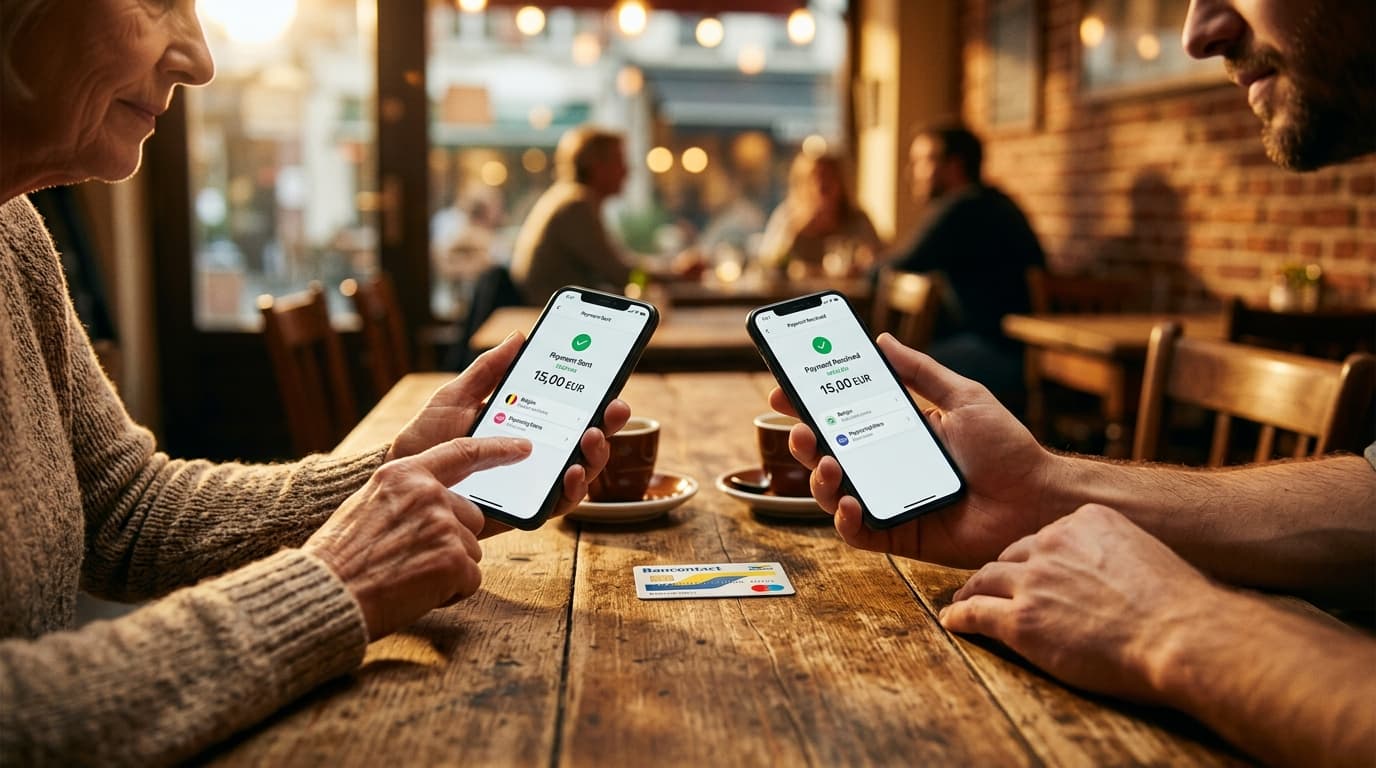
Since November 2024, major Belgian banks have offered Wero — an instant payment system that transfers money from account to account in seconds, bypassing Visa and Mastercard entirely. KBC, Belfius, ING and BNP Paribas Fortis have integrated it into their apps, with more banks following in 2026. The question many Belgians are asking: do you still need a credit card when you have Wero? The short answer: yes, and for very concrete reasons.
How does Wero work in Belgium?
Wero is built on SEPA instant credit transfers (SCT Inst) and operates from bank account to bank account. When you send money via Wero, the amount leaves your account and arrives in the recipient's account within ten seconds — 24 hours a day, 7 days a week, including public holidays.
Identification works through mobile phone number or QR code. No need to know the recipient's IBAN. You open your banking app, select Wero, enter the amount and the recipient's phone number, confirm — done.
The European Payments Initiative (EPI), a consortium of European banks and payment providers, developed Wero to create an alternative to the American networks Visa and Mastercard. EPI shareholders include BNP Paribas, Deutsche Bank, ING and KBC. EPI acquired Payconiq International — the technology parent of Bancontact Payconiq Company (Belgium) — in October 2023. The stated goal: a sovereign European payment ecosystem, from P2P transactions to in-store payments. As of March 2026, Wero had 51.8 million users across Europe, with ING Belgium alone reporting over one million users in February 2026.
Which Belgian banks offer Wero in 2026?
The Belgian rollout happened in two waves.
Wave 1 — November 2024. KBC, CBC, Belfius, ING and BNP Paribas Fortis activated Wero in their mobile applications. These five banks cover over 80% of current accounts in Belgium.
Wave 2 — first half of 2026. Argenta, Crelan, Bank Van Breda and vdk bank joined the system. Beobank has announced an integration later in 2026.
| Bank | Wero launch | Compatible app |
|---|---|---|
| KBC / CBC | November 2024 | KBC Mobile / CBC Mobile |
| Belfius | November 2024 | Belfius Mobile |
| ING | November 2024 | ING Banking |
| BNP Paribas Fortis | November 2024 | Easy Banking |
| Argenta | 2025-2026 | Argenta App |
| Crelan | 2025-2026 | Crelan Mobile |
| Bank Van Breda | 2025-2026 | Bank Van Breda App |
| vdk bank | 2025-2026 | vdk app |
Neobanks are not all connected to Wero in Belgium yet. Revolut has joined EPI and plans a progressive integration in the second half of 2026 for Belgium (P2P and e-commerce). N26 signed an agreement with EPI in December 2025 and plans to launch in Germany, France and the Netherlands in the second half of 2026 — Belgium is not yet confirmed. Wise and Bunq are not yet connected. For a complete neobank comparison, see our Revolut vs N26 guide.
Does Wero replace your credit card?
No. The two systems serve different purposes, and the credit card retains advantages that Wero does not offer.
What the system does well:
- Instant transfers between individuals — splitting a bill, reimbursing a friend, paying a tradesperson
- E-commerce payments at connected merchants (live since 3 March 2026 in Belgium — Ahold Delhaize, Lidl, Pairi Daiza, bpost, Just Russel and Parfum Dreams among the first)
- In-store payments via QR code (expected during 2026)
- No fees between individuals at participating Belgian banks
What it does not do:
- Limited buyer protection — for e-commerce payments, Wero allows disputes within 120 days, but this protection is less comprehensive than Visa/Mastercard chargeback. P2P transfers are irreversible
- No travel insurance, no cancellation cover, no car rental CDW
- No revolving credit or deferred payment
- No payments outside the EPI zone (United States, United Kingdom, Asia, Africa)
- No deposit guarantee for hotels or car rentals
- No native (account-to-account) NFC tap-to-pay in stores before the second half of 2027 — an interim version via existing card rails is planned for autumn 2026
The credit card remains essential for anything beyond instant transfers: renting a car in Belgium requires a credit card for the deposit, paying outside the eurozone requires a globally accepted Visa or Mastercard network, and chargeback offers a protection no bank transfer can match.
Wero vs Bancontact: how do they coexist in Belgium?
Bancontact is the Belgian standard for in-store payments: 1.9 billion transactions in 2024, accepted at over 280,000 merchants. Wero targets a broader scope — the entire European market — but starts from zero in terms of merchant acceptance.
The convergence between the two is already under way. EPI acquired Payconiq International — the technology parent of Bancontact Payconiq Company — in October 2023, and the Payconiq brand is disappearing by end of 2026. In practice, Payconiq's P2P and QR code functions are migrating to Wero, while debit card payments at terminals remain under the Bancontact Pay brand. For now, the two systems coexist:
| Criterion | Bancontact | Wero |
|---|---|---|
| Scope | Belgium only | EPI zone (BE, DE, FR, NL...) |
| In-store | Contactless NFC + QR code | QR code (2026), NFC (2027) |
| Online | Bancontact Payconiq | Rolling out (2026) |
| P2P | Payconiq between individuals | Instant transfers |
| Merchant acceptance | 280,000+ in Belgium | Under construction |
| Technology | Bancontact network | SEPA instant transfer |
For Belgian consumers, the shift will be gradual. Bancontact is not disappearing — it is integrating into the EPI/Wero ecosystem. The long-term goal is a unified system that works across the entire eurozone.
What does Wero change for payment security?
Wero uses strong customer authentication (SCA) required by the PSD2 directive: every payment is confirmed through biometrics (fingerprint, Face ID) or a PIN code in the banking app. The risk of interception fraud is low — there is no card number to steal, no CVV, no expiry date.
Buyer protection is more limited than with a credit card. For e-commerce payments via Wero, a dispute mechanism exists: you can flag an issue within 120 days through your banking app, and your bank assesses the case for a potential refund. But for P2P transfers, a confirmed payment is final. By comparison, Visa and Mastercard chargeback covers a broader range of situations (unfulfilled bookings, deposits, international purchases) and relies on standardised network rules. In cases not covered, your recourse remains contacting the merchant directly or going through mediation (Ombudsfin, Consumer Mediation Service).
For online purchases on unknown or foreign websites, the credit card offers far stronger protection than Wero. Reserve Wero for transactions with trusted individuals or merchants.
Do you need both Wero and a credit card, or is one enough?
Both serve complementary needs.
"Instant transfer is enough" profile: you only pay in Belgium and the eurozone, you do not rent cars, you do not travel outside Europe, and your online shopping is limited to well-known Belgian sites. The Wero + Bancontact duo covers your needs.
"Credit card is essential" profile: you travel outside the eurozone, you rent cars, you buy online from international sites, you need travel insurance linked to the card, or you want the ability to dispute a payment if something goes wrong. The credit card is the only tool that combines worldwide payment + buyer protection + credit.
The most effective strategy: instant transfers for person-to-person payments and everyday spending (free, instant), and a credit card for online purchases, travel and spending that requires protection. For transactions outside the eurozone, check our guide on hidden credit card fees before choosing your card.
When will Wero be available as NFC tap-to-pay?
Wero's NFC rollout will happen in two stages. From autumn 2026, EPI plans a first version of NFC contactless payment that will route through existing card networks (CB, Visa, Mastercard). True account-to-account NFC payment — bypassing card networks entirely — is scheduled for the second half of 2027. This means you will be able to hold your phone near a payment terminal and pay via Wero, exactly like Apple Pay or Google Pay today.
Until then, in-store payment uses a QR code displayed on the terminal. It works but is less seamless than tap-to-pay. For fast contactless payments in 2026, the bank card (Bancontact, Visa or Mastercard) remains more practical.
What Wero is preparing for Belgium's future
EPI has structured the Wero rollout in three phases:
- P2P (active) — instant transfers between individuals, integrated into Belgian banking apps
- E-commerce (in progress) — online payments at partner merchants, deployed since early 2026
- Point of sale (2026-2027) — in-store payments via QR code then NFC
Geographic coverage is expanding progressively. Germany and France launched the system alongside Belgium. The Netherlands and other eurozone countries are following. The long-term ambition: a pan-European payment network capable of competing with Visa and Mastercard for everyday transactions.
For Belgian credit card users, the realistic scenario is lasting coexistence. Wero will capture a share of domestic and intra-European payments. The credit card will keep its role for international payments, buyer protections and related services (insurance, credit, cashback). The two tools reinforce each other rather than compete.
Comparator Guides & Advice
Compare side by side.
Compare now →
Frequently asked questions
Keep reading
Sophie L. worked eight years in a Belgian bank branch, first as a credit adviser and then in customer relations, before going independent in 2021 and settling in Louvain-la-Neuve. Her work starts with the issuers' official fee schedules, from the high-street banks (ING, BNP Paribas Fortis, KBC, Belfius) to the neobanks (Revolut, N26, Wise), reduced to five comparable lines: annual fee, currency conversion charge, borrowing rate, spending limits and bundled insurance. Every price on this site carries the date it was checked: the annual-fee grid was gone through line by line on 12 August 2026, after Belfius moved its Beats Star package to 5.90 € a month in February. If an issuer does not publish a figure, she writes that down instead of estimating it. For readers who moved to Belgium, she spells out what a Belgian issuer expects from an applicant with no local credit history.